A book at Yale has defeated every attempt to read it since it surfaced in 1912. That is an enigma in the plain dictionary sense: someone or something puzzling, mysterious or hard to make sense of. Plenty of famous enigmas turn out to be far less baffling than their reputation, and a few are every bit as stubborn as they sound. What separates the two groups is usually whether anyone has gone back and checked the evidence.
Enigmas Explained: What the Word Means
Dictionaries date the first recorded English use of enigma to 1530–40, from Latin and Greek roots tied to speaking in riddles. In classical rhetoric it named a figure of speech that tucked its meaning inside a riddle or a metaphor, so the listener had to work for it. Today the word is broader: it can describe a person or a thing that is mysterious, puzzling or hard to figure out, and its adjective form is enigmatic.
Enigma, Riddle or Mystery?
A riddle is built to be solved, since it is a question or saying with a hidden answer. A mystery is simply something nobody has explained yet. An enigma sits between the two: Dictionary.com notes that it can mean a literal riddle but is more often used for something so baffling it feels like one, maybe even by design.
Thesauruses split it the same way. As an unexplained puzzle, enigma sits near mystery, secret and closed book; as a problem to be worked out, near riddle, conundrum and brain-teaser. Famous enigmas tend to start out as the first kind and get treated as the second, once someone decides the puzzle can be cracked.
When a Person Is an Enigma
Calling someone an enigma means their motives for what they say and do are hard to read. It usually points to a character that seems puzzling or contradictory, not merely quiet. Some people play the part on purpose, to seem mysterious. A typical use is the friend you have known for years who is still a total enigma, with no clue to their interests or real character.
The Bermuda Triangle: A Mystery Built After the Fact
Status: debunked.
Since the mid-20th century, a patch of the Atlantic has carried the reputation of swallowing ships, planes and people without explanation. The legend has a traceable start: a Miami Herald article by Edward Van Winkle Jones, sent out by the Associated Press on September 17, 1950, first suggested unusual losses near Bermuda. A 1952 Fate magazine article by George X. Sand then drew the triangle on the map.
Its best-known case is Flight 19, five Navy Avenger torpedo bombers that disappeared on a training flight on December 5, 1945. Navy investigators put it down to a navigation error that left the planes out of fuel.
Larry Kusche, author of The Bermuda Triangle Mystery: Solved (1975), went back to the records and found that many famous cases were exaggerated, dubious or impossible to verify, and some happened well outside the triangle. He concluded that ships and planes went missing there no more often, proportionally, than anywhere else at sea.
The officials agree. According to the U.S. Navy and Coast Guard, nothing supernatural is needed to explain what goes wrong at sea, and the federal Board of Geographic Names does not accept the Bermuda Triangle as an official place name. NOAA points to ordinary hazards instead: most Atlantic tropical storms and hurricanes cross the area, the Gulf Stream can turn the weather quickly, and shallow water around the Caribbean islands is tricky to navigate. Lloyd’s of London found no unusual number of sinkings there and charges ships nothing extra to pass through.
The Enigma Machine: Cracked by Mathematicians
Status: solved.
The one enigma here that literally carries the name was a German cipher machine. It began as a commercial product in the early 1920s, and Germany and the other Axis powers later turned it into a military tool that served them through World War II. Inside, a rotor mechanism scrambled the 26 letters of the alphabet; one operator typed, and a second wrote down which of 26 lamps lit up with each key press.
It looked close to unbreakable, but its design left faint patterns in the scrambled text. Polish mathematician Marian Rejewski first cracked it in December 1932, and Poland went on reading German messages from before the war into it. In July 1939, weeks before Germany invaded Poland, Rejewski helped teach French and British codebreakers the Polish methods.
Germany kept improving the machine, which slowed the work down, but the codebreaking carried on through the whole war, much of it at Britain’s Bletchley Park, where Alan Turing was among the codebreakers. Many commentators say the intelligence that came out of it, known as Ultra, shortened the war substantially.
The Antikythera Mechanism: An Ancient Greek Computer
Status: mostly solved.
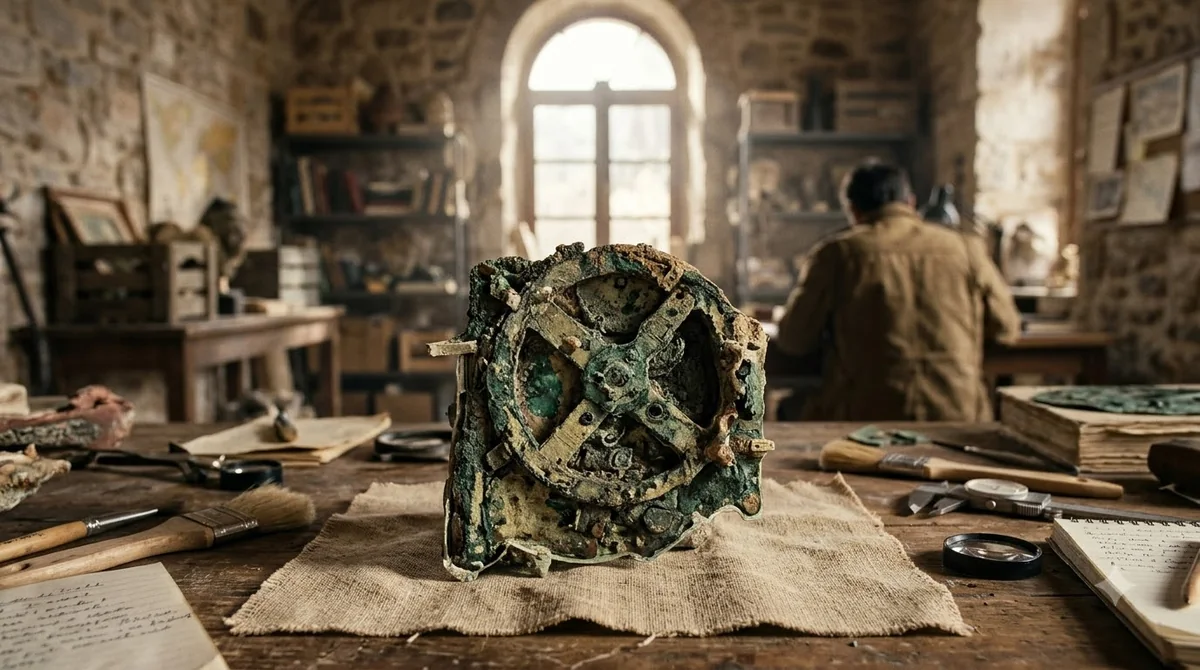
In early 1900, sponge divers from the Greek island of Symi found an ancient shipwreck off Antikythera. Among the finds was what looked like a lump of corroded bronze and wood, and it took decades to work out what it was.
What It Did
In 1902 the Greek politician Spyridon Stais, visiting the National Archaeological Museum in Athens, noticed a gear in one of the fragments. Modern scans point to 35 interlocking bronze gears, and 30 of them can still be seen. Turning a hand crank set every gear moving at once, working out where the Sun and Moon stood, the phase of the Moon, eclipses and calendar cycles. It even kept track of the four-year cycle of the ancient Olympic Games.
That makes it the oldest known example of an analog computer. Nothing of similar complexity appears for around 1,500 years, until the fourteenth-century astronomical clocks of Europe.
What Is Still Unknown
Who built the mechanism, and when, is still argued over. Proposed construction dates range from 205 BC to about 87 BC, and it must be older than the wreck, which is dated to roughly 70–60 BC. Suggested birthplaces include the Corinthian colonies, the city of Pergamon and an academy on Rhodes founded by the philosopher Posidonius. Some researchers also suspect that a missing part of the machine tracked the five planets known in antiquity.
The Nazca Lines: Giant Pictures in the Desert
Status: half solved.
The desert floor of southern Peru, a little more than 200 miles (320 km) from Lima, carries over 800 straight lines, 300 geometric shapes and 70 pictures of animals and plants. Some lines run up to 30 miles (48 km), and the figures measure from 50 to 1,200 feet (15 to 366 m) across.
How They Were Made
The method is no longer a puzzle. The makers removed the top 12 to 15 inches (30 to 38 cm) of rust-dark rock and earth to expose pale sand underneath, leaving a “negative” image. Rain and wind barely touch the place, so the designs have survived mostly undamaged for somewhere between 500 and 2,000 years. They are so hard to make out from the ground that the wider world only noticed them once commercial pilots began flying over Peru in the 1930s.
Why They Were Made
The purpose is where the arguments start. American professor Paul Kosok watched the sun set in line with one of the lines on June 22, 1941, and called the desert “the largest astronomy book in the world”. German researcher Maria Reiche then studied the lines for 40 years and argued for an astronomical and calendar purpose.
From the 1970s, new research challenged that reading. National Geographic Explorer-in-Residence Johan Reinhard argues that most lines led to places where people held rituals for water and crop fertility, and researcher Anthony Aveni also ties the lines and trapezoids to water rituals. In a region that gets about 20 minutes of rain a year, that makes sense, and the figures fit it: spiders were believed to signal rain and hummingbirds fertility. Reinhard holds that no single method proves it, but that archaeology, ethnohistory and anthropology together make a solid case. Researchers still expect that picture to shift as new technology reaches the desert, so the question of purpose is best called half answered.
Oak Island’s Money Pit: Still Unsolved
Status: unsolved.
The most widely told version begins in the summer of 1795, when a teenager named Daniel McGinnis found a hollow in the ground on Oak Island, Nova Scotia. That story did not appear in print until 1857, more than 60 years later. According to the account, diggers hit a platform of oak logs at 10 feet (3 m) and another at 20 feet (6 m).
At about 90 feet (27 m), the diggers lifted out a flat stone carved with symbols nobody present could read. The stone was later lost, so no proposed translation can be checked against it. Then the shaft flooded overnight, and a full day and night of bailing barely lowered the water by a few inches.
The website of the TV series The Curse of Oak Island lists what the pit has given up since: wood, scraps of parchment, coconut fiber and bits of human bone, yet not one piece of treasure that has survived authentication. The coconut fiber puzzled searchers, since the nearest coconut palms grow more than 1,500 miles (2,400 km) away, but its 11th-to-14th-century date may belong to old packing from a ship’s cargo, not to the shaft.
Skeptic Joe Nickell argues there is no treasure at all, only a natural sinkhole connected to limestone caverns. Marine geologist Gordon Fader and historian Joy Steele likewise say the island’s bedrock and sinkholes can explain the flooding. The basic question is still open, though: who dug the first shaft, when, and for what reason remains unknown.
The Voynich Manuscript: The Book Nobody Can Read
Status: unsolved.

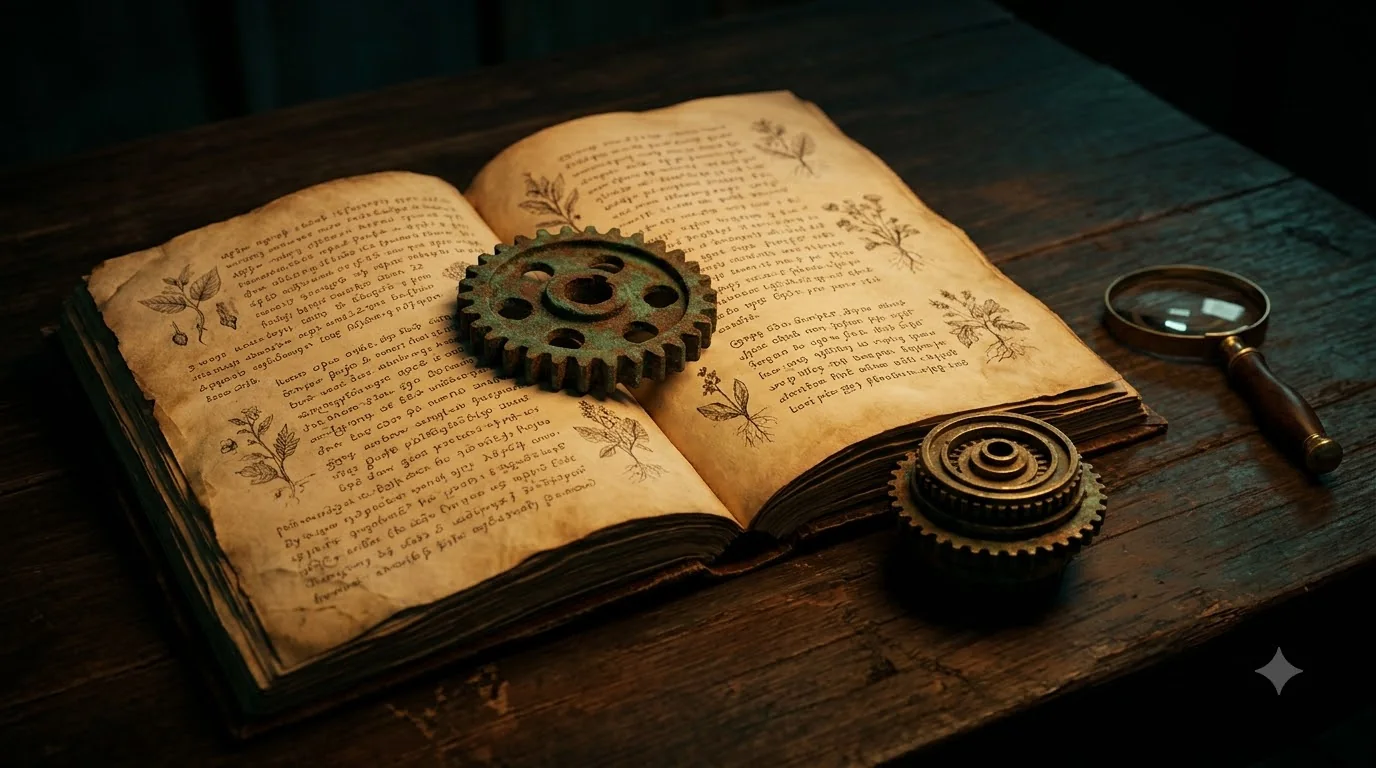
Yale’s Beinecke Library lists it as MS 408: an anonymous book in a script no one has identified. It turned up for sale in 1912, offered by Wilfrid M. Voynich, a Polish-American dealer in rare books, and it still carries his name. Its parchment has been carbon-dated to 1404–1438, in tests run at the University of Arizona in 2009.
The drawings offer hints, falling into sections on plants, astronomy and astrology, bathing, cosmology and herbal medicine, plus unillustrated pages that may be recipes. Its first confirmed owner, Holy Roman Emperor Rudolph II, paid 600 gold ducats for it in the belief that the medieval scholar Roger Bacon wrote it, a link the library calls pure speculation.
Codebreakers have tried for more than a century. No one has shown a working decipherment, and not one of the competing theories, from a lost or invented language to a cipher or an elaborate hoax, has been independently confirmed. Of the six enigmas here, it is the one anyone can try for themselves: the library has put high-resolution images of the whole manuscript online.
Where All Six Stand Now
| Enigma | Status | Settled by, or still open |
|---|---|---|
| Bermuda Triangle | Debunked | Settled by records showing no more losses than other busy waters |
| Enigma machine | Solved | Settled by Polish, then British, codebreakers |
| Antikythera mechanism | Mostly solved | Open: who built it, and exactly when |
| Nazca Lines | Half solved | Open: why the lines were drawn |
| Oak Island Money Pit | Unsolved | Open: who dug the shaft, and why |
| Voynich manuscript | Unsolved | Open: what the text says |
Real enigmas, it turns out, are a status rather than a permanent condition. The Bermuda Triangle lost its mystery once someone checked the records, and the Enigma machine lost its to mathematics. The two that still hold out share one thing: the evidence that would settle them, a readable key or a documented first dig, has never surfaced.
Sources
- The Beinecke Cipher (Voynich) Manuscript (yale.edu)
- Voynich manuscript – Wikipedia (wikipedia.org)
- ENIGMA Definition & Meaning | Dictionary.com (dictionary.com)
- enigma (byu.edu)
- Enigma – Definition, Meaning & Synonyms (vocabulary.com)
- Bermuda Triangle – Wikipedia (wikipedia.org)
- What is the Bermuda Triangle? (noaa.gov)
- Enigma machine – Wikipedia (wikipedia.org)
- Antikythera mechanism – Wikipedia (wikipedia.org)
- Why the Nasca lines are among Peru’s greatest mysteries (nationalgeographic.com)
- Oak Island mystery – Wikipedia (wikipedia.org)
- The Oak Island Money Pit: Discovery, Depth and Finds Since 1795 (thecurseofoakisland.com)