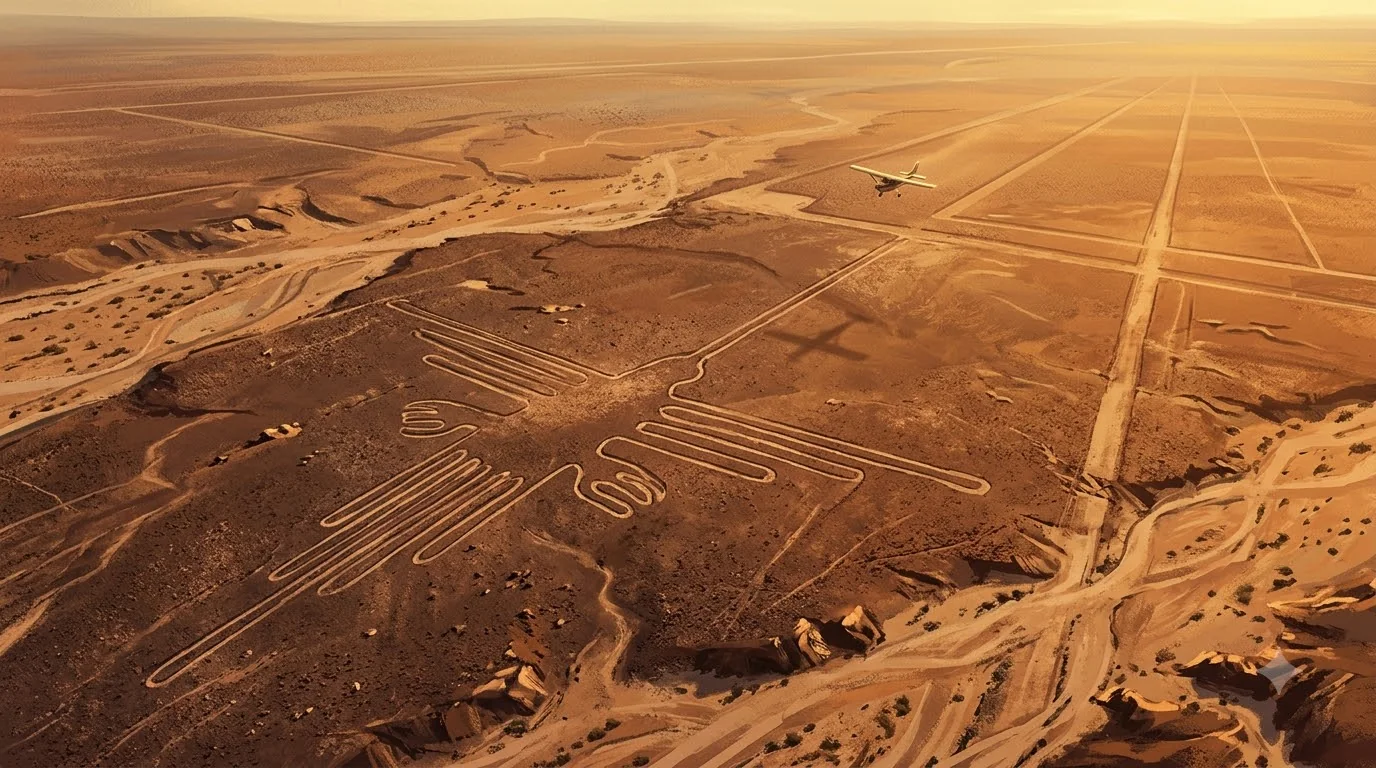
The Nazca Lines are hundreds of giant drawings scraped into the desert of southern Peru between 500 BC and AD 500. How they were made is no longer a mystery; why anyone made them is still argued over. The figures are best seen from the air, which helped feed some of the wildest theories about them.
What the Nazca Lines Are
The drawings cover a stretch of desert a little more than 200 miles (320 km) southeast of Lima, near the town of Nasca. National Geographic counts more than 800 straight lines, 300 geometric shapes and 70 pictures of animals and plants. Some lines stretch for up to 30 miles (48 km), and the animal figures run from 50 to 1,200 feet (15 to 366 m) long.
A few of the best known have been measured precisely: the hummingbird is 305 feet (93 m) long, the condor 440 feet (134 m), the monkey 305 by 190 feet (93 by 58 m) and the spider 154 feet (47 m). UNESCO listed the whole area as a World Heritage Site in 1994.
How They Were Made
The method turns out to be simple. The desert floor is covered in stones that have weathered to a dark rust color; clear away the top 12 to 15 inches (30 to 38 cm) and pale sand shows through, leaving a “negative” image. Most lines are only shallow trenches, about 4 to 6 inches (10 to 15 cm) deep. Because the region sees almost no rain, wind or erosion, the designs have lasted largely intact for 500 to 2,000 years.
Laying them out did not need anything exotic either. Researchers think the makers used basic tools and simple surveying, and the how has proved far easier to answer than the why. Wooden stakes have turned up at the ends of some lines, and radiocarbon dating of one of them helped fix the age of the whole complex.
The most direct proof came from a reconstruction. The investigator Joe Nickell recreated the figures using only tools the Nazca had, showing that a small team could lay out even the biggest designs in a matter of days with no view from above, and sinking the 1969 claim by Erich von Däniken that “ancient astronauts” were responsible. Scientific American described his copy as “remarkable in its exactness.”
Why They Were Made
The Astronomy Theory
Serious study began in 1926, with the Peruvian archaeologist Toribio Mejia Xesspe. On June 22, 1941, the American professor Paul Kosok watched the sun go down exactly in line with one of the lines and called the desert “the largest astronomy book in the world”. It is the same kind of idea that draws crowds to Stonehenge at the solstice.
The German researcher Maria Reiche carried the astronomy theory on for decades and became the lines’ fiercest protector, even living in a small house at the edge of the desert to keep careless visitors off them. The star-calendar reading held until the 1970s, when a new wave of American researchers arrived.
Water and Ritual
A view that has gained a lot of ground ties the lines to water. In 1985, the archaeologist Johan Reinhard showed that the worship of mountains and water sources sat at the center of Nazca religion, and he read the lines as sacred paths to the places where those gods were honored. In his words, most lines “did not point at anything on the geographical or celestial horizon, but rather led to places where rituals were performed to obtain water and fertility of crops”.
Anthony Aveni, a former National Geographic grantee, reached a similar conclusion: the lines and trapezoids were “related to water,” he says, but used for rituals rather than for finding it. In a desert that gets only about 20 minutes of rain a year, that focus makes sense. Even the animals fit, since in Andean symbolism spiders signal rain, hummingbirds fertility and monkeys the water-rich Amazon.
Still Not Settled
Reinhard himself is careful: no single line of evidence proves the theory, he says, though archaeology, ethnohistory and anthropology together “build a solid case.” That is a strong argument, not a closed file.
New Figures Keep Turning Up
New figures are still turning up. A Yamagata University team announced two small new figures in 2011, and with IBM Japan it reported 143 more in 2019. In 2024, working with IBM Research, the same institute used artificial intelligence to flag candidates and confirmed 303 previously unknown figures, including parrots, cats, monkeys and killer whales, after a survey on foot that ran from September 2022 to February 2023 and took 1,440 labor hours.
The site is also fragile. In December 2014, Greenpeace activists damaged it by setting up a banner inside the lines of one of the figures.
What the Lines Cannot Tell Us
The Nazca Lines are often called a mystery, but the evidence points somewhere fairly specific: people in a desert desperate for water, walking and marking paths that mattered to their gods. What the lines cannot tell us, and no excavation can recover, is exactly what those people believed. Like the Antikythera mechanism or the Voynich manuscript, the object is in plain view; the meaning is what got lost.
Sources
- Nazca lines – Wikipedia (wikipedia.org)
- Why the Nasca lines are among Peru’s greatest mysteries (nationalgeographic.com)