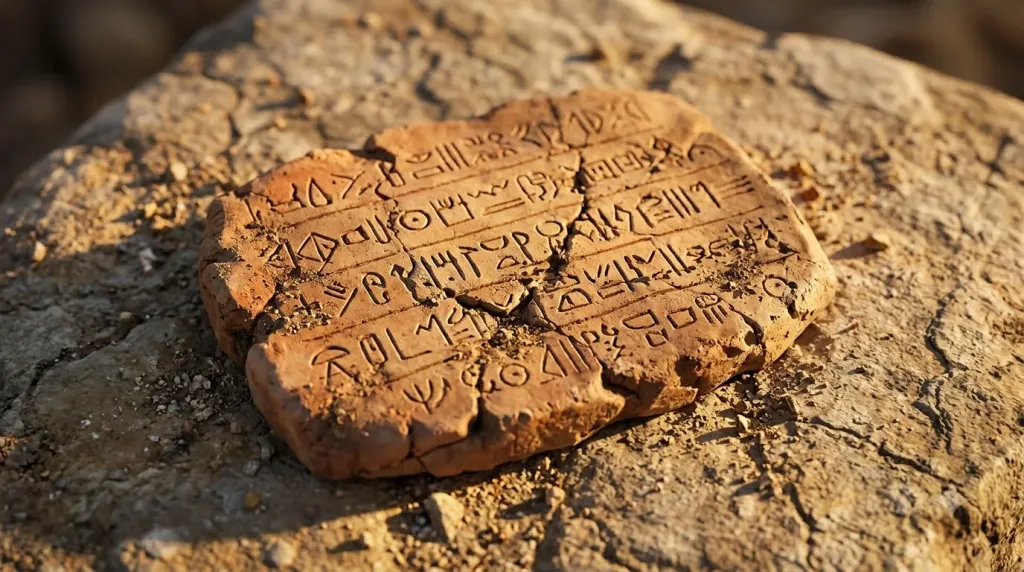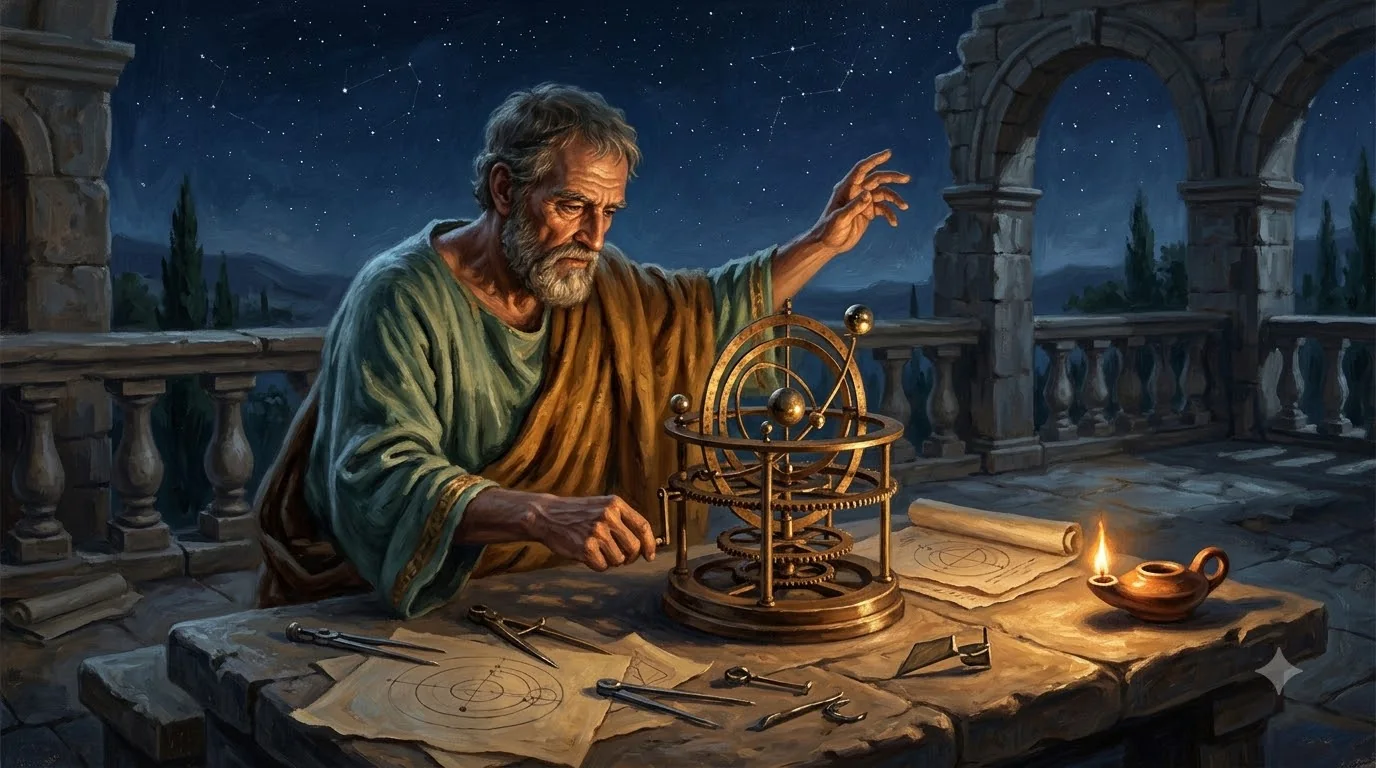
More than two thousand years ago, someone in the Greek world built a hand-cranked machine that showed where the Sun, the Moon and the planets would be on any chosen day. The Antikythera mechanism, recovered from a shipwreck and identified in the early twentieth century, is the oldest known analog computer. It survives only as corroded scraps, yet researchers have worked out most of what it did.
What the Antikythera Mechanism Is
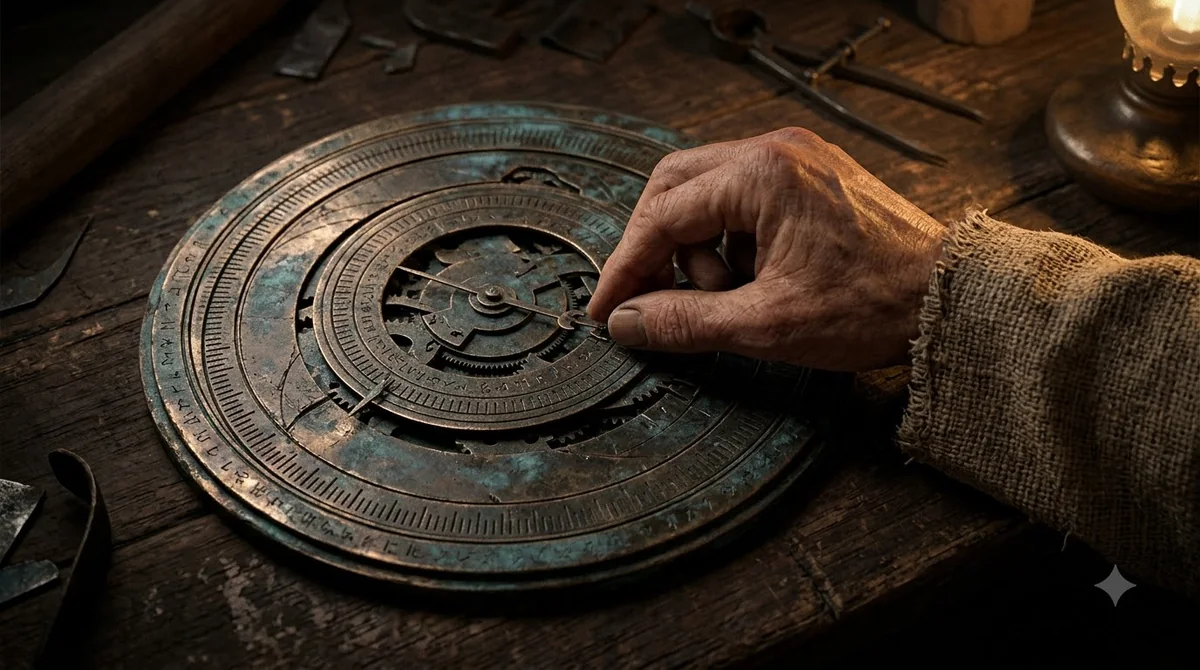
Strictly speaking, the Antikythera mechanism is an orrery, a working model of the heavens, built in Greece in the second century BC. What is left today is broken into 82 fragments, roughly a third of the original, including 30 bronze gearwheels eaten by corrosion. The largest piece, Fragment A, is about 7 by 6 inches (180 by 150 mm), weighs 369.1 grams (13 ounces) and still holds 27 of those gears.
All of the fragments are in the National Archaeological Museum in Athens, displayed next to replicas that show how the device probably looked and worked.
From Sponge Divers to X-Rays
The story starts with a wreck. In early 1900, Captain Dimitrios Kontos and a crew of sponge divers from the island of Symi found an ancient ship off Antikythera, and the Greek navy helped bring up its cargo over the following year. In 1902, the politician Spyridon Stais spotted a gear in one of the museum’s lumps of bronze, and his cousin Valerios Stais, who ran the museum, began the first study.

The idea that it calculated the sky came from the German philologist Albert Rehm. His notes from 1905–06 even sketched a display of rings for the planets, though he had too little evidence to get the mechanics right.
Real progress needed better eyes. The historian Derek de Solla Price took up the puzzle in 1951, and in 1971 he and the physicist Charalampos Karakalos X-rayed all 82 fragments, publishing the results in 1974. In 2005, a Cardiff University team led by Mike Edmunds went further, using computer tomography to look inside the crusted pieces and read faint text that once covered the outer case.
What It Could Do
The Back: Calendars and Eclipses
The back of the box held five dials. The two big ones were a Metonic dial, a calendar that kept lunar months in step with the solar year, and a Saros dial that predicted eclipses. A smaller one, now called the Games dial, followed the four-year cycle of athletic festivals like the ancient Olympics.
The Front: A Moving Model of the Sky
The front showed the sky itself. One ring carried the Egyptian calendar of twelve 30-day months plus five extra days, so the user could line it up with the zodiac. The Moon’s pointer held a small ball painted half white and half black that turned to show the lunar phase. Around the dials ran a parapegma, an early almanac of star risings and weather signs.
Rebuilding the Planet Display
The hardest part was the planets. Inscriptions revealed by X-ray scans describe the motions of the Sun, the Moon and all five planets visible to the naked eye, shown on the front as a model of the Greek cosmos, but no earlier reconstruction had matched those numbers. The text even calls the display a planetarium, with the planets as “little spheres” and the Sun as a “little golden sphere.”
A team working at University College London has since published a model of that display that fits the evidence. It uses nine nested rings, one each for the Moon, its orbital nodes, Mercury, Venus, the Sun, Mars, Jupiter, Saturn and the date. Two numbers in the inscriptions, 462 for Venus and 442 for Saturn, were key to working out the gearing.
Who Built the Mechanism, and When
Here the certainty runs out. The machine has to be older than the wreck, which is dated to about 70–60 BC. One 2014 study pushed the date back to around 200 BC, reading the Saros dial’s starting point as a lunar month that began just after the new moon of April 28, 205 BC.
The calendar on its Metonic dial follows the Corinthian pattern, but in 2017 researchers showed it cannot be the calendar used in Syracuse. Its almanac also fits latitudes between 33.3 and 37.0 degrees north, and the island of Rhodes, a center of Greek astronomy, falls inside that band.
Ancient writers knew of devices like it. The Roman statesman Cicero, in his dialogue De re publica, mentions a pair of machines credited to Archimedes that tracked the Sun, the Moon and the five known planets; both were taken to Rome after Syracuse fell in 212 BC. Whether the Antikythera mechanism descends from that tradition is still argued.
A Machine Out of Its Time
Nothing of comparable complexity appears again for about 1,500 years, until the astronomical clocks of fourteenth-century Europe. That gap is the real enigma. A machine like this does not appear from nowhere: the Antikythera mechanism proves the skill existed in the ancient world; what it cannot tell us is how many others were built, and why the knowledge vanished. It sits beside other ancient puzzles, from the Nazca Lines to Stonehenge, as a reminder that ancient engineers were often far ahead of what later centuries remembered.
Sources
- Antikythera mechanism – Wikipedia (wikipedia.org)
- A Model of the Cosmos in the ancient Greek Antikythera Mechanism – Scientific Reports (nature.com)