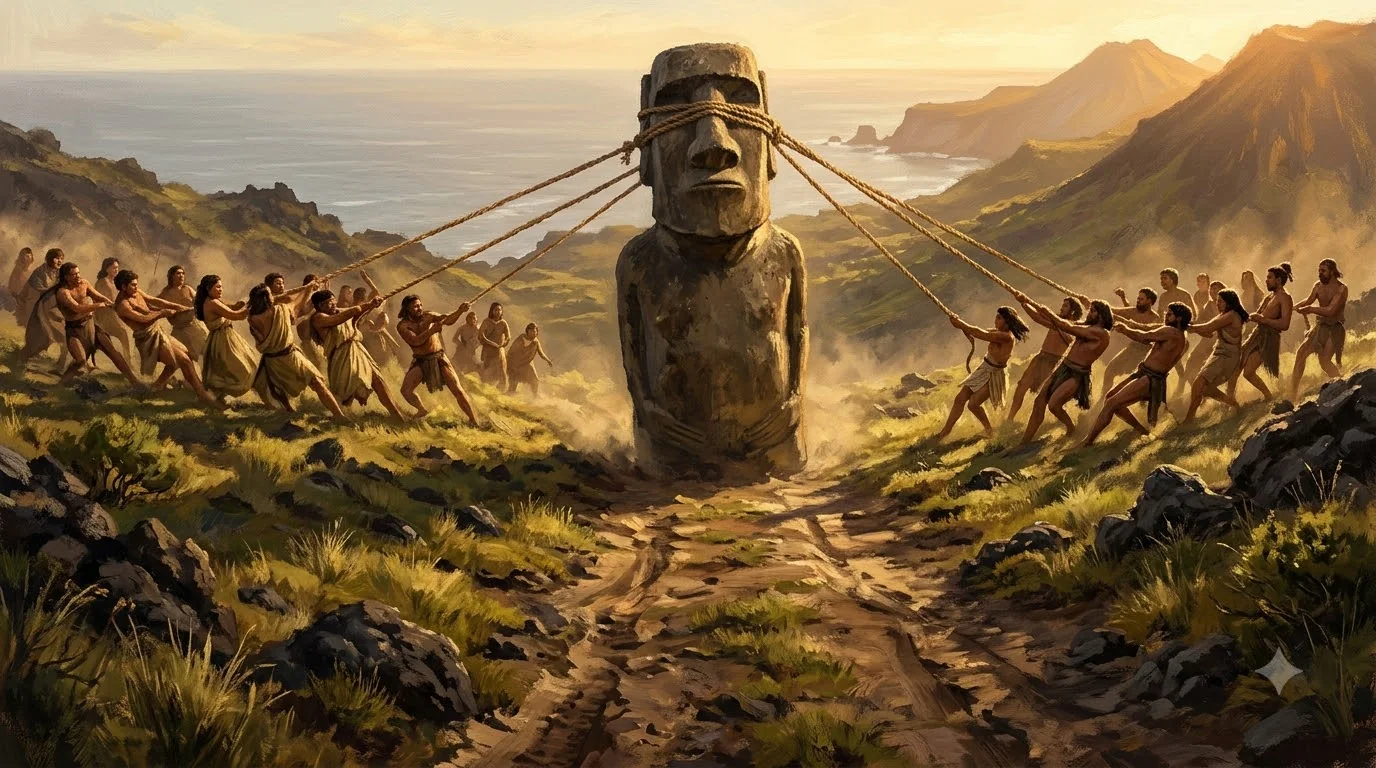
The Easter Island statues weigh many tons each, and some stand miles from the quarry where they were carved. The best answer to how they got there is surprisingly simple: the islanders “walked” them, rocking each statue upright from side to side with ropes. Experiments with a replica show that a small team can do it in under an hour over a short distance.
What the Easter Island Statues Are
The statues, called moai, are human figures carved from single blocks of stone by the Rapa Nui people between 1250 and 1500. More than 900 are known, and all but 53 were cut from compressed volcanic ash at the Rano Raraku quarry, where 394 can still be seen in various stages of completion. Nearly half never left the quarry; hundreds were moved to stone platforms, called ahu, around the edge of the island.
A typical moai stands about 13 feet (4 m) tall and 5.2 feet (1.6 m) wide at the base. The tallest ever set upright, known as Paro, reached almost 33 feet (10 m) and weighed about 90 tons; an unfinished figure still in the quarry would have stood about 69 feet (21 m) tall if completed.
They were more than sculpture. The moai are understood as the living faces of deified ancestors, and objects made with the right rituals were believed to hold a spiritual power called mana. Their eye sockets once held coral eyes with obsidian or red scoria pupils, a detail archaeologists confirmed in 1979.
The Puzzle of Moving Them
For a long time, researchers assumed the islanders dragged the statues lying down, on wooden sledges or rollers along prepared tracks. The trouble is scale: moving the largest erected moai that way would have taken an estimated 1,500 people.
Upright transport was tested decades ago. In 1986, the engineer Pavel Pavel worked with the explorer Thor Heyerdahl and the Kon-Tiki Museum on statues of five and nine tonnes, and Heyerdahl estimated that a 20-tonne moai could cover about 330 feet (100 m) a day that way.
The Walking Theory
What the Statues Reveal
The strongest case comes from anthropologists Carl Lipo of Binghamton University and Terry Hunt of the University of Arizona. After studying nearly 1,000 moai, they concluded that the islanders tied ropes to each statue and walked it forward in a zig-zag along purpose-built roads. Their 3D models show features that only make sense for that method: wide, D-shaped bottoms and a slight tilt toward the front, which let a statue rock from one edge to the other.
The Replica Experiment
To test it, they made a 4.35-ton copy that tilts forward like the originals. Eighteen people moved it 330 feet (100 m) in about 40 minutes, far faster than earlier attempts to move a statue upright. As Lipo put it, “Once you get it moving, it isn’t hard at all”; the tricky moment is starting the rocking.
Roads Built for Walking
The island’s ancient roads fit the theory too. They are about 15 feet (4.5 m) wide and dished in the middle, a shape that steadies a statue as it rocks forward, and many of them overlap or run side by side, as if a new stretch was cleared for each move. Lipo and Hunt’s paper, titled “The Walking Moai Hypothesis,” appeared in the Journal of Archaeological Science.
Is the Question Settled?
For now, walking upright is the method most scholars accept. Lipo goes further: in his view no other explanation fits the evidence, and he dares critics to show that the statues could not have walked. That said, much of the case comes from Lipo and Hunt, the researchers who proposed the idea, so the question is best called largely settled rather than closed; independent tests would make it firmer. The work also credits the islanders themselves, showing, in Lipo’s words, “that the Rapa Nui people were incredibly smart”.
Why So Many Statues Were Toppled
The statues did not stay up. Islanders brought them down during the late eighteenth and early nineteenth centuries, a collapse that may trace to the shock of European contact or to fighting between clans. After the Dutch navigator Jacob Roggeveen arrived in 1722, every moai standing on a platform was eventually toppled, and by 1868 none remained upright except partly buried ones on the slopes of Rano Raraku. Many standing today were put back in modern times, such as the row at Ahu Tongariki, restored in the 1990s by the Chilean archaeologist Claudio Cristino.
Engineering, Not Magic
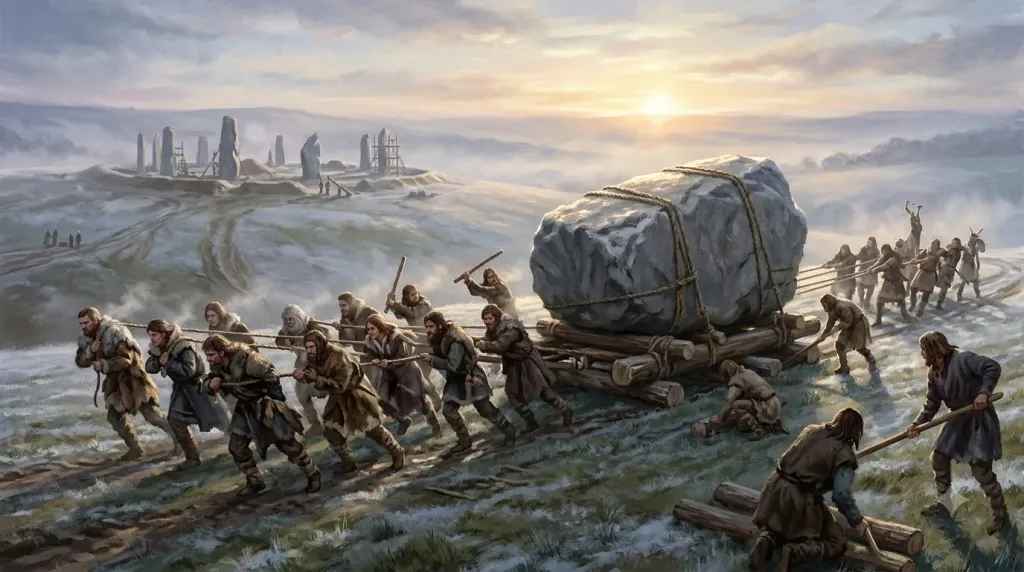
Moving giant stones without wheels or draft animals is a problem shared by many ancient builders, from Rapa Nui to the people who brought Stonehenge’s stones across Britain. With the Easter Island statues, at least, the engineering answer turned out to be rope, roads, careful design and a few dozen people who knew exactly what they were doing.
Sources
- Easter Island’s statues actually “walked” – and physics backs it up (eurekalert.org)
- Moai – Wikipedia (wikipedia.org)
- Scientists just proved the moai could walk, solving a 500-year mystery (sciencedaily.com)