Linear A is the writing system of the Minoans, the Bronze Age people of Crete, and nobody alive can read it. Scribes used it from about 1800 BC to 1450 BC. Experts can even sound out its words, since most of its signs carried over into a later script that was cracked in 1952, but the words belong to a language no one recognizes.
What Linear A Is
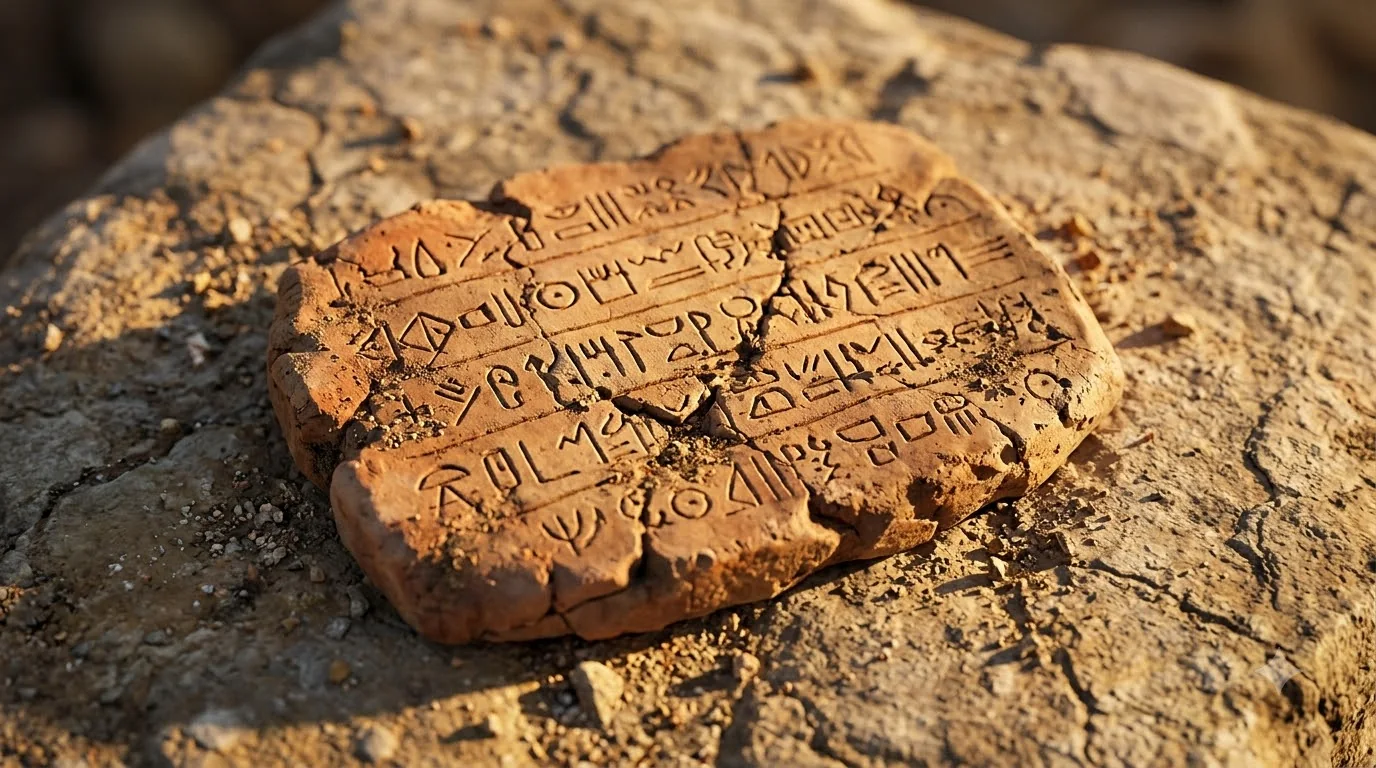
The name comes from the archaeologist Sir Arthur Evans, who called the script “Linear” because its signs were drawn as simple lines in clay, unlike the more picture-like Cretan hieroglyphs of the same era, which are also unread. The Minoans wrote it on clay tablets, stone offering tables, vessels, pottery and even gold and silver hairpins.
The surviving material is small. One count puts the readable corpus at roughly 1,400 inscriptions, holding about 7,400 individual signs, with another 1,100 objects too damaged to use. Roughly half of all known inscriptions come from one site, Hagia Triada in southern Crete.
Many are religious. Brent Davis, a University of Melbourne archaeologist who wrote his doctoral thesis on the script, points out that the Minoans left inscribed ritual objects by the hundreds at outdoor shrines, and that the dedications on them repeat with small variations, which reveals a surprising amount about the grammar behind them.
The Script That Was Cracked: Linear B
The Minoan script has a famous child. When Greek speakers reached Crete late in the Bronze Age, they borrowed the Minoan signs to write their own language, producing the script known as Linear B. In 1952, the English architect Michael Ventris cracked it, building on groundwork by the American classicist Alice Kober.
His breakthrough came from the language, not the signs. Ventris had been convinced the texts were Etruscan or some other ancient tongue; once he realized they were Greek, Davis says, the rest was only a matter of time.
That success is exactly what makes the older script so frustrating. The two share many signs, and those signs probably stood for similar sounds, yet every attempt to read the Minoan texts with Linear B values produces a language no scholar understands.
Why Linear A Still Can’t Be Read
Not Enough Text
According to Davis, the decisive problem is quantity. Ventris worked from roughly 20,000 signs of Linear B, and without a parallel text in a known language, that is about the minimum needed; for the Minoan script, there are only about 8,000.
A parallel text would change everything. The Rosetta Stone, which carries the same decree in Egyptian and Greek, is the classic example: read one version, and you can work out the other. Nothing like that has turned up on Crete.
No Known Language
The other problem is that nobody knows which language to test. Davis calls identifying the language the first great key to any decipherment. Comparisons have been tried with two Anatolian languages, Luwian and Lycian, and with Semitic ones like Phoenician and Ugaritic, but none has produced a convincing match.
What Researchers Have Worked Out
Even unread, the inscriptions give up clues, and researchers have pieced together a little grammar. The language seems to have built words by stacking prefixes and suffixes, and endings such as -RU and -RE look like grammatical case markers. A handful of words can be guessed from context, the most secure being KU-RO, which appears at the bottom of lists and seems to mean “total.”
The work rests on a tiny community. Davis estimates that only eight to 10 people worldwide study the undeciphered scripts of the Aegean seriously; besides the Minoan script, the main ones are Cretan Hieroglyphic and Cypro-Minoan.
Could Linear A Ever Be Deciphered?
Davis is cautiously hopeful that it will be deciphered one day. Most known signs come from a single large archive, so one new archive could raise the total dramatically, and excavations on Crete keep finding new Minoan palaces, which is where archives tend to be. For him, the prize is clear: reading these texts would let the Minoans speak in their own words for the first time.
Unlike the Voynich manuscript, which may or may not hide a real language, this script certainly records one, used by a civilization that shaped early Greece. It is a mystery with a clear solution waiting in the ground, if the right archive survives.
Sources
- Linear A – Wikipedia (wikipedia.org)
- Decoding the Everest of scripts | 3010 (unimelb.edu.au)
- Linear B – Wikipedia (wikipedia.org)