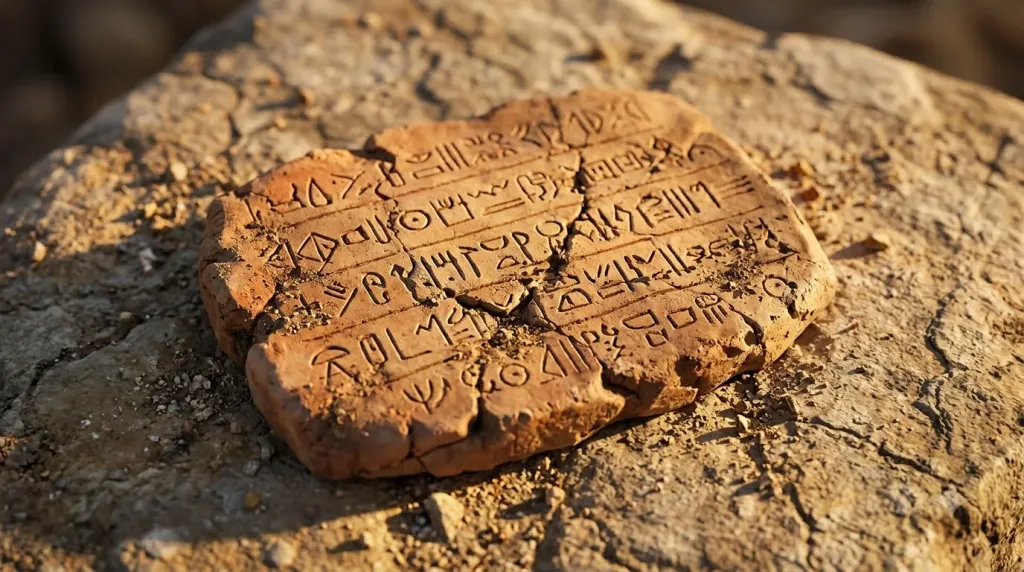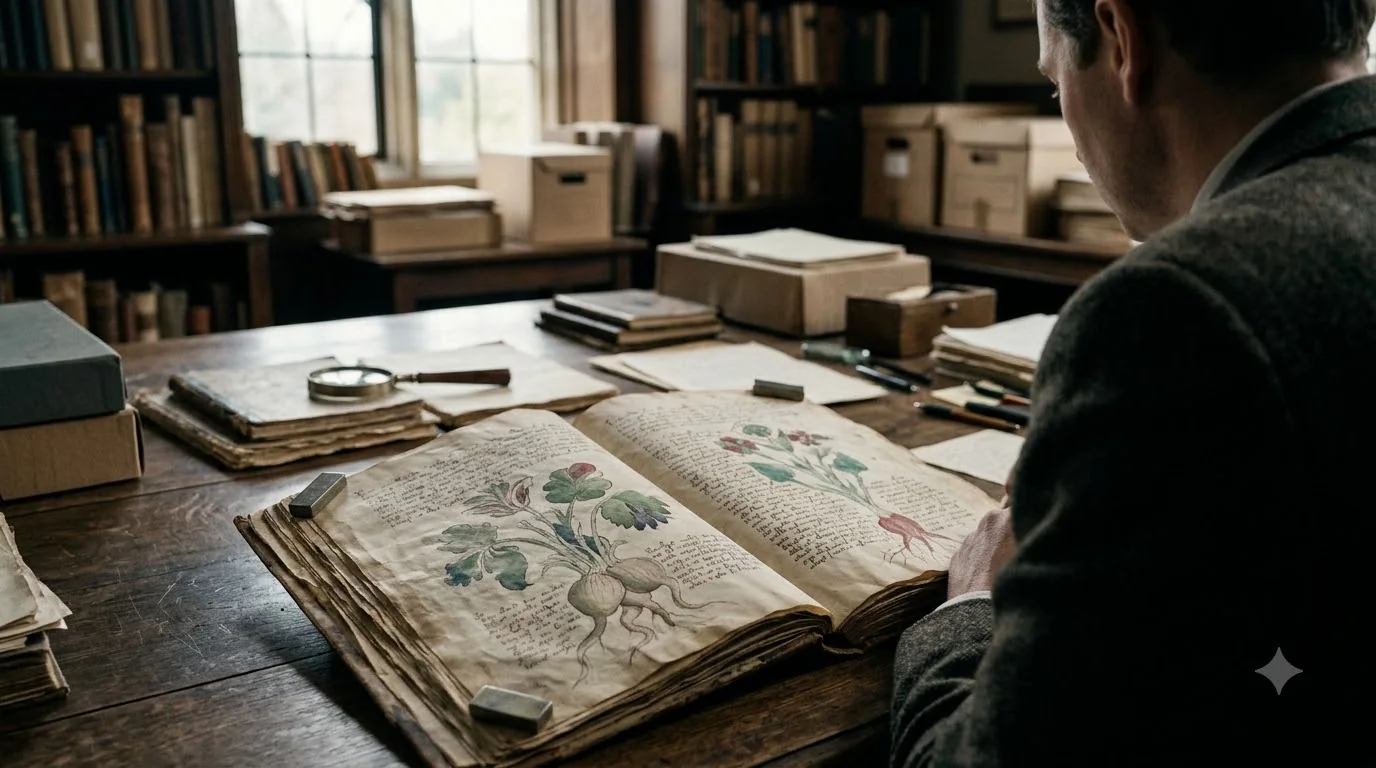
The Voynich manuscript is a handwritten book, kept at Yale, that no one has managed to read since it surfaced in 1912. Its parchment dates to the early fifteenth century, its author is unknown, and its alphabet matches no known writing system. Wartime codebreakers, linguists and computer scientists have all taken a run at it, and the text still keeps its secret.
What the Voynich Manuscript Is
Physically, the manuscript is small enough to hold in one hand: roughly 9.3 by 6.4 inches, and 2 inches deep (23.5 by 16.2 cm, 5 cm deep). Its vellum leaves are sewn into 18 gatherings of different thickness, and 240 of what were once 272 pages survive. The writing, nicknamed Voynichese, runs left to right, and several pages fold out into larger sheets.
Radiocarbon tests carried out at the University of Arizona in 2009 dated the vellum to 1404–1438. That dates the animal skin rather than the ink, but it rules out the idea that the book is a modern forgery on old-looking paper. Stylistic clues have led some researchers to suggest it was made in Renaissance Italy.
What fills the manuscript is easier to describe than to explain. Yale’s Beinecke Library sorts the drawings into six groups: plants, astronomy and astrology, scenes of bathing, round cosmological diagrams, herbs and roots drawn like a pharmacy guide, and long unillustrated passages that may be recipes.
Who Owned the Book
The book’s history is better documented than its text. Its first confirmed owner was Holy Roman Emperor Rudolph II, who reportedly paid 600 gold ducats for it in the belief that the English friar Roger Bacon had written it, a link the library calls pure speculation. It then passed to the pharmacist Jacobus Horčicky de Tepenec and, by 1637, to the alchemist Georg Baresch, also spelled Barschius.
Baresch could not read it either. He had heard that Athanasius Kircher, a Jesuit scholar in Rome, had published a Coptic dictionary and claimed to have cracked Egyptian hieroglyphs, so he mailed him a sample of the script twice and asked for help. His letter of 1639 is the earliest confirmed mention of the manuscript. Kircher seems to have wanted the book for himself, but Baresch would not part with it.
It reached Kircher anyway. In 1666 the scholar Johannes Marcus Marci, who had inherited it, sent it to Rome with a covering letter that is still kept inside the volume. Centuries later, in 1912, Wilfrid M. Voynich purchased it from a Jesuit college at Frascati, outside Rome, and his name has stuck to it ever since. Yale’s Beinecke Library has held it since 1969, and it has left the building only once, for a 2014–15 exhibition at the Folger Shakespeare Library.
Why No One Can Read It
The Codebreakers Who Tried
The book has drawn professional cryptographers as well as amateurs, including American and British codebreakers who had served in both world wars. Some of the best of the twentieth century, among them William and Elizebeth Friedman, Prescott Currier and John Tiltman, worked on it without success. One of the earliest serious attempts came in 1921, from William Romaine Newbold of the University of Pennsylvania.
What the Statistics Show
Counting the words turns up patterns that look like a real language. Its commonest word occurs roughly twice as often as the runner-up and three times as often as the word in third place, the pattern linguists call Zipf’s law, which natural languages follow.
Other patterns look odd. The same common word can appear up to five times in a row. Certain letters are also highly predictable in particular positions within words, which makes the text less varied than most languages. That mix, partly language-like and partly mechanical, is exactly why the debate has never closed.
The Leading Theories
The leading theories fall into two camps: an elaborate hoax, or a real language or cipher that nobody has cracked.
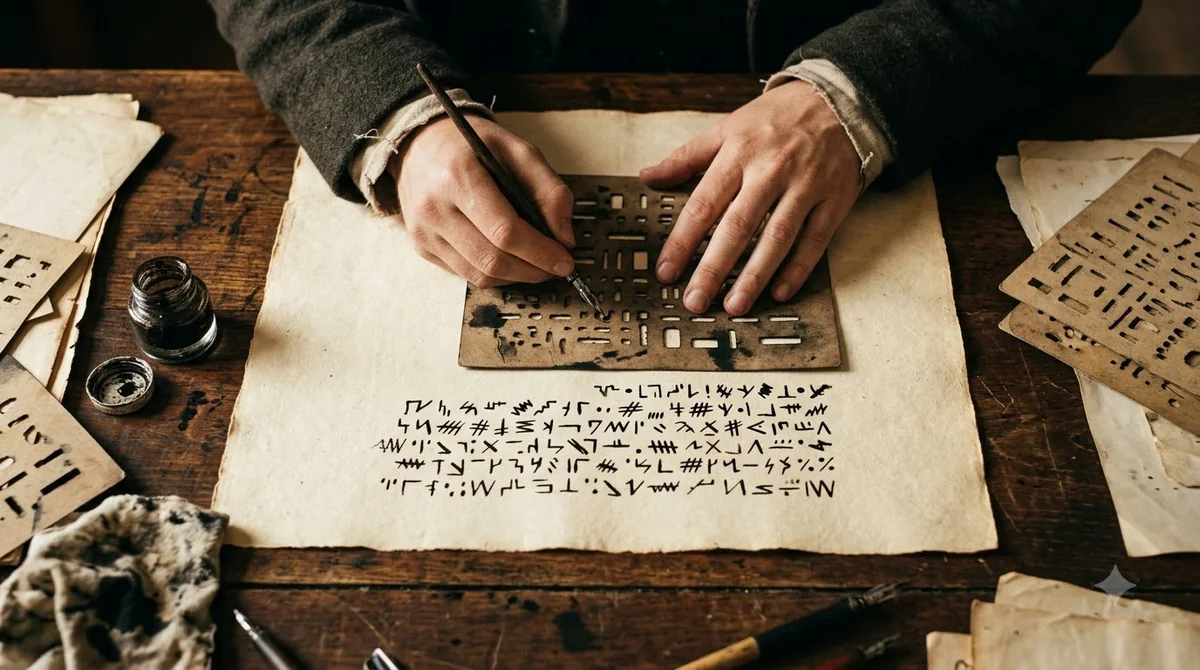
A Clever Hoax
In 2003, computer scientist Gordon Rugg produced text with similar features by drawing word beginnings, middles and endings from a table, choosing them through a card with holes cut in it. The catch is timing: that kind of stencil, the Cardan grille, appeared around 1550, more than a century after the parchment was made. Critics also argue that Rugg’s imitation only looks alike on the surface and that the same trick could mimic almost any language.
Claimed Solutions
New “solutions” appear every few years. In 2014, linguistics professor Stephen Bax self-published what he called a “provisional, partial decoding,” offering readings for ten proper nouns and fourteen letters. In September 2017, TV writer Nicholas Gibbs said the book was Latin in a personal shorthand, mostly a borrowed medical handbook for women; Lisa Fagin Davis, who heads the Medieval Academy of America, answered that his version “doesn’t result in Latin that makes sense.” A few months later, in February 2018, engineer Ahmet Ardıç argued that the text was a language descended from Old Turkic.
None of these has held up. The Voynich manuscript has never been demonstrably deciphered, and without a translation or outside context, scholars cannot properly test any theory or rule one out. That puts it in a small club of unread writing, alongside the Bronze Age script Linear A from Crete.
How to See It for Yourself
The original is fragile, so the library keeps it under restricted access, but high-resolution images of every page are online. Yale put the complete book in its digital library in 2020. You can see it for yourself there: zoom in on the plant pages, the star charts and the bathing scenes, and compare the script from page to page. It is one of the few famous enigmas anyone can study in full from a phone.
The Book That Keeps Its Secret
Most famous mysteries fade once someone finds the right document. This one is the reverse: the object is fully available, measured, dated and photographed, and the mystery is entirely in what it says. Until a second text in the same script or a genuine key turns up, the best anyone can do is count its words.
Sources
- The Beinecke Cipher (Voynich) Manuscript (yale.edu)
- Voynich manuscript – Wikipedia (wikipedia.org)