Who built Stonehenge? Not one people at one moment, but generations of Neolithic and Bronze Age Britons, working in phases over at least 1,500 years. The first work, a circular ditch and bank, began around 3000 BC, and the stones kept being rearranged for centuries afterward. Their reasons are less certain than their dates, but the evidence keeps pointing to the dead, the sun and very large gatherings.
Who Built Stonehenge, and When
The monument grew in stages. Builders dug the ditch and bank first, around 3000 BC, and placed human remains there for at least the next 500 years. A second phase followed between about 2900 and 2600 BC, and the famous ring of huge sarsen stones went up between 2600 and 2400 BC. The smaller bluestones reached their present positions between 2400 and 2200 BC, though they may have stood on the site as early as 3000 BC.
The builders may also have left their camp behind. Two miles (3 km) away lies Durrington Walls, which the archaeologist Mike Parker Pearson sees as the builders’ camp. Animal teeth found there point to crowds of up to 4,000 people feasting at midwinter and midsummer at some point between 2600 and 2400 BC.
What Stands on Salisbury Plain
The outer ring on Salisbury Plain was made of sarsens about 13 feet (4 m) tall, 7 feet (2.1 m) wide and around 25 tons each, capped by horizontal lintels locked on with woodworking-style mortise and tenon joints, something no other monument of the time has. A ring of smaller bluestones sits inside. The whole layout lines up with the sunrise at the summer solstice and the sunset at the winter solstice.
UNESCO added the site and its surroundings to its World Heritage list in 1986, and today the monument belongs to the Crown Estate and is run by English Heritage.
Where the Stones Came From
The Sarsens
The giant sarsens came from fairly close by. A study published in 2020 traced them to West Woods, about 16 miles (26 km) away.
The Bluestones
The bluestones traveled much farther. Most researchers accept that they came from the Preseli Hills in Pembrokeshire, Wales, about 150 miles (240 km) away. Work led by Parker Pearson between 2017 and 2021 went further, suggesting they first stood in a stone circle of the same size at Waun Mawn in the Preseli Hills, which was taken apart and moved. An older idea, that glaciers carried them most of the way, struggles because there is no sign of glacial deposits in southern central England.
The Altar Stone
The biggest surprise came recently. The Altar Stone, a flat sandstone slab at the center that is the largest of the bluestones at about 16 feet (4.9 m) long, had an unknown source. An earlier guess placing it in Pembrokeshire was ruled out once the rock’s makeup and mineral ages failed to match. Then a recent study traced its mineral grains to the Old Red Sandstone of northeast Scotland, meaning the 6-tonne block traveled at least 466 miles (750 km).
Moving it that far overland, across hills and rivers, would have been so difficult that the researchers think it went by sea, which implies a well-organized society connecting distant parts of Britain.
How the Stones Were Moved
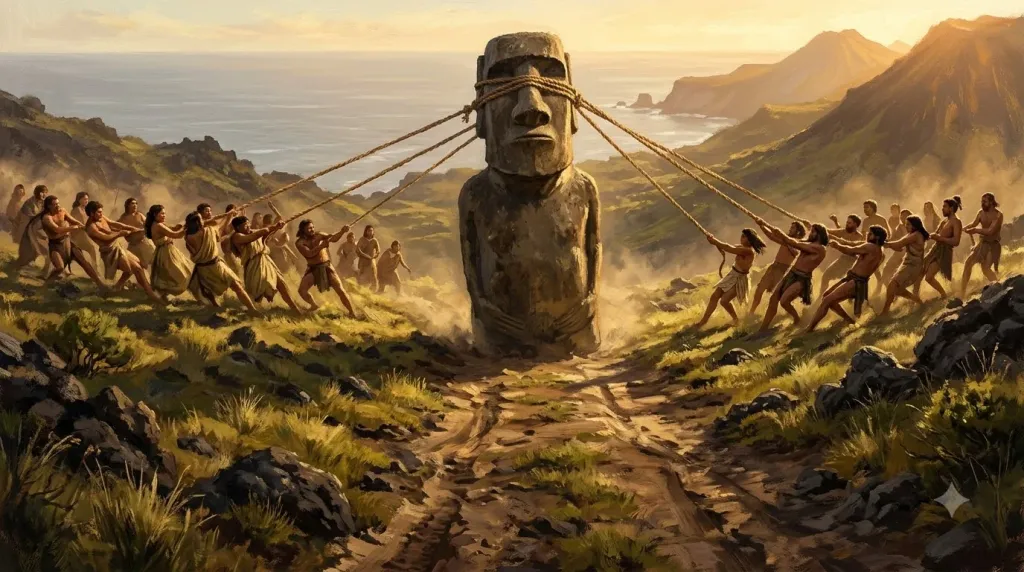
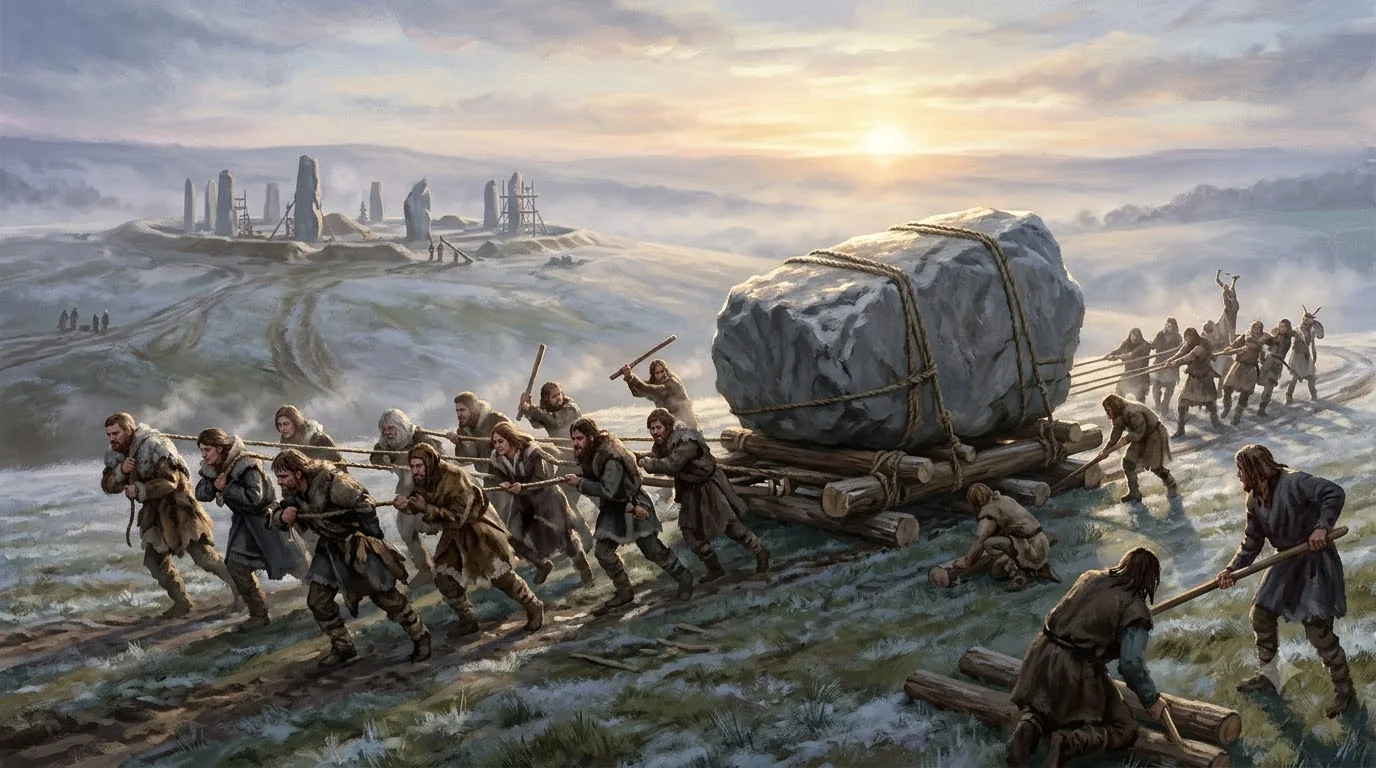
For the smaller bluestones, which weighed about 2 tons each, one proposal is that teams lifted and carried them on rows of poles or pole frameworks, a method recorded in China, Japan and India. It is still unknown whether they came straight from their quarries or were taken from an older circle in Wales and rebuilt on Salisbury Plain. For the Altar Stone, the best guess is a journey by boat. The same question, how people moved enormous stones without wheels, hangs over other ancient sites, from Easter Island’s moai to the temples of Egypt.
Why Stonehenge Was Built
The strongest clue is death. Parker Pearson, who led the Stonehenge Riverside Project, concluded that the monument “was a place of burial from its beginning to its zenith”, which he puts in the middle of the third millennium BC. Around it lies England’s richest concentration of Neolithic and Bronze Age monuments, including several hundred burial mounds.
The sky is the other clue. The solstice alignment was clearly deliberate, and the crowds gathering nearby for midwinter and midsummer festivals suggest those dates mattered deeply. A burial ground built to face the turning points of the year fits both lines of evidence.
A Monument Built by an Island
So who built Stonehenge? Farming communities of prehistoric Britain, over many generations. The monument is less a single mystery than a long project: stones hauled from Wiltshire, Wales and Scotland, thousands of people gathering for the solstice, and the dead buried in its shadow. Like the Nazca Lines, its alignments show people tracking the sky; unlike them, it shows that prehistoric Britain was far better connected than anyone once believed.
Sources
- Stonehenge – Wikipedia (wikipedia.org)
- A Scottish provenance for the Altar Stone of Stonehenge – Nature (nature.com)