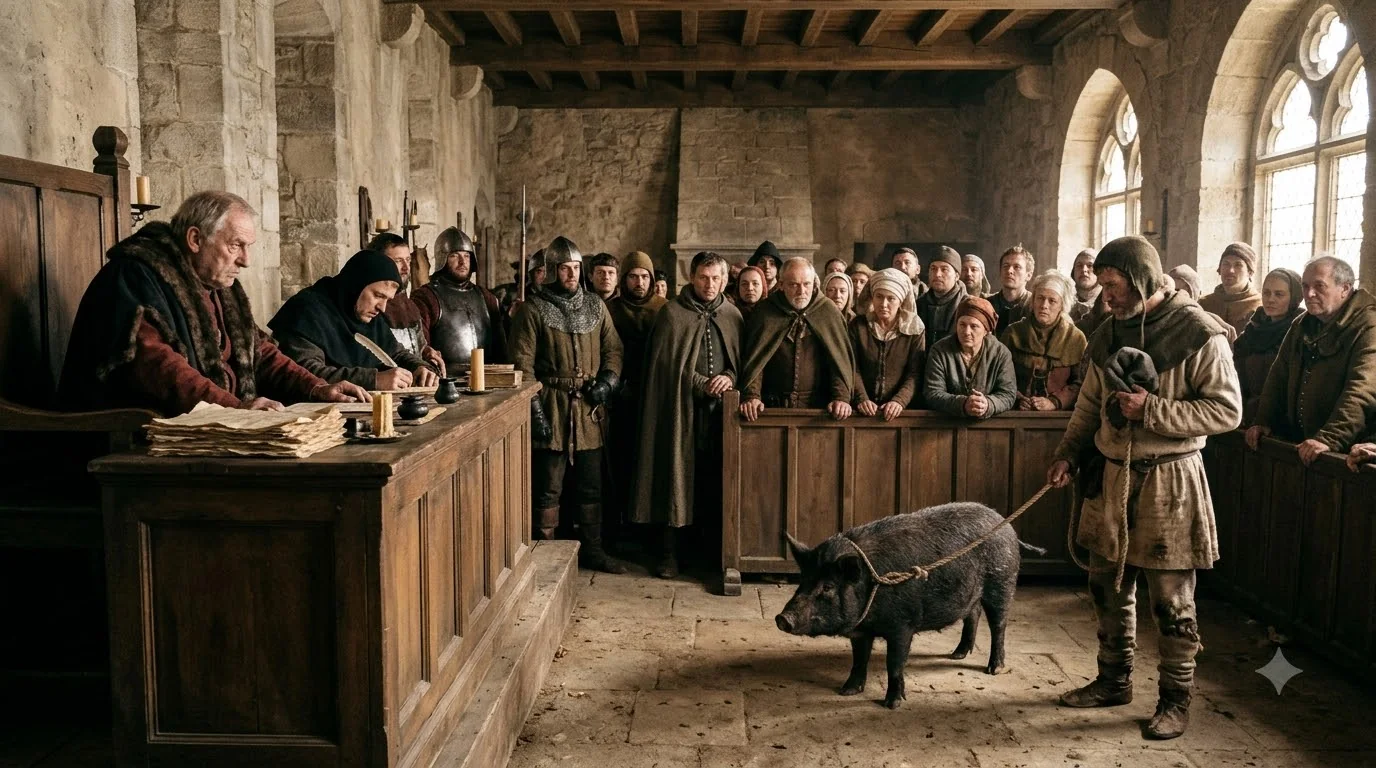
One of the most famous animal trials left a receipt. It records payment for having “dragged and then hanged” a sow of about three years old, plus reimbursement for a new glove the hangman used during the execution. Yes, animals were put on trial in medieval and early-modern Europe, and they went through the same legal forms as human defendants: custody, formal charges, witnesses, a verdict and a public sentence. Most of the best-documented cases come from France, and the surviving records leave open how many there were, when the practice began and why it existed.
How Common Were These Trials?
Animal trials appear across medieval and early-modern Europe, and France is especially well represented, with more than 100 known cases dating from the tenth to the 18th century. The totals vary from one account to the next. Records survive for at least 85 medieval trials across Europe, and many of them took place in France and Switzerland. Edward P. Evans was the first to write about the topic, in a 1906 book, and his count comes to close to 200 trials from the period. Many more probably went unrecorded.
The span that stands out most is roughly the 13th to 16th centuries, when prosecutions of swine were especially frequent across Europe.
Pigs were the most frequently tried animals, and the charges against them often involved a child who had been killed or maimed. From the 13th to the 16th century especially, swine were brought to court across Europe on charges ranging from attacks on children to damage to property and, in some cases, homicide. The earliest pig trial on record was held in 1266 at Fontenay-aux-Roses, a town near Paris. From Normandy and the Île-de-France, the custom spread to Burgundy, Lorraine, Picardy and Champagne, and later reached Italy, Germany and the Low Countries.
Two Kinds of Animal Court
Medieval animal trials ran in two separate systems. Secular courts, usually run by local lords, tried domestic animals such as pigs, bulls, horses, donkeys, mules and cows. Church courts, run by bishops and their officials, took on creatures that damaged a community’s property, including rats, field mice, weevils, locusts, eels and ants.
The split follows the kind of harm involved. Secular courts usually dealt with a single animal that had hurt a person, often a child who had been killed or maimed, while church courts took up cases about crops, vineyards and goods that belonged to a whole community. Jurisdiction also tracked the animal’s status: church courts heard cases against creatures regarded as wild, such as rats, field mice, eels, locusts and ants, while secular authorities handled pigs, horses, asses, dogs and sheep.
Custody and Charges
The process began with custody. Accused animals were held in jail. At Savigny, the sow and her six piglets were kept as prisoners of the local lady until their trial. Formal charges followed, often drawn up in very precise language. A pig had to be charged with “murdering” a child, not “killing” one. The historian Lesley Bates MacGregor argues that this exactness was part of a ritual concern with getting the legal process right.
Owners were not bystanders. If an owner knew the animal had a dangerous habit, he could himself be hanged. If he swore he was unaware of it, he paid a fine for the death and the animal was confiscated.
Hearing and Testimony
The case then went before a bailiff or judge, sometimes after a spell in prison. Attorneys presented arguments, evidence was examined and witnesses were summoned. The Savigny record names nine witnesses who were present at the hearing and mentions “several others.”
Verdict and Sentence
The outcome was rarely in doubt, and most accused animals were found guilty and condemned. A 1494 case near Clermont, where a pig was arrested on June 14 for strangling and disfiguring an infant in its cradle, shows the formal tone of the verdict. The judge declared that the court acted “in detestation and horror of the said crime, and to the end that an example may be made and justice maintained,” and ordered the pig hanged on a wooden gibbet beside the gallows.
Hanging was the usual method, but not the only one. A pig at Fontenay-aux-Roses was burned at the stake, and in 1557 a pig at Saint-Quentin was “buried alive.” Appeals could soften a sentence. A donkey and a pig first condemned to death later had their sentences reduced to corporal punishment. Executions were public, and in some cases the animal’s body was dressed in human clothes and displayed in town.
Did Animals Get Lawyers?
Whether an animal received a lawyer depended on the court. In some church cases, animals were notified of the charge against them and assigned a defender. Secular courts were less consistent about this.
Savigny, a case heard in a lord’s court, shows the other side. The surviving record names the lady of Savigny’s prosecutor and her advocate, Benoît Milot of Autun, but no lawyer for the pigs. The formal defendant was their owner, Jehan Bailly. The judge asked him three times whether he had any reason to give why justice should not be done, and he said he had nothing to say.
The sixteenth-century lawyer Bartholomew Chassenée defended rats accused of eating and destroying a barley crop. Chassenée argued that the rats could not safely make the journey to court, since the greatest peril on the way was the cats that hunted them. Other lawyers took a different line, saying the animals had a place in the created order or that they had to feed to stay alive.
Falaise, 1386: The Best-Documented Case
In 1386, a pig was hanged in Falaise, a town in Normandy, for murder, and a crowd gathered to watch. The condemned animal had been tried, its witnesses heard and its sentence passed. The case began with a sow that attacked a baby lying in its cradle in Falaise. Contemporary records say the sow ate the face of Jonnet le Macon’s infant, and that the infant died of its injuries.
Officials seized the sow and brought her to the local court, which found her guilty and condemned her to death. The hangman was paid for the work, and the local government spent ten sous and ten deniers on the spectacle, including a new pair of gloves for the hangman. Executioners received new gloves after hanging a human too, a sign that they incurred no sin in carrying out the sentence.
The execution itself is considered almost certain to have happened, although historians debate whether every detail of the later accounts holds up. Accounts written afterward describe the sow’s snout and one foreleg as mutilated before her execution, a detail that seems to have mirrored the child’s injuries. The sow was hanged in the public square.
The case was later commemorated in a church fresco in Falaise, painted on the Church of the Holy Trinity’s west wall. That fresco survived for more than four centuries before it was whitewashed in the 19th century, so written descriptions are now the only record of it.
Savigny, 1457: A Sow, Her Piglets and a Split Verdict
Falaise is the famous case, but Savigny, a village in Burgundy, shows how a court handled a whole family. On the Tuesday before Christmas, a sow killed five-year-old Jehan Martin, the son of a villager of the same name. She and her six piglets were caught in the act and held as prisoners of Katherine de Barnault, the lady of Savigny. On January 10, 1457, the case came before her judge, with the pigs’ owner, Jehan Bailly, standing as the defendant.
The prosecutor blamed the killing on Bailly’s negligence, but the sentence fell on the sow. After taking counsel from “wise men and practitioners” and weighing the custom of Burgundy, the judge ordered her hanged by her hind feet from a tree, because the lady’s own gallows was not standing at the time.
The piglets received a different ruling. They had been found stained with blood, but nothing showed that they had eaten from the boy, so the judge postponed their case. He offered to return them to Bailly if he posted bail, paid for their feed and agreed to hand them back should new evidence turn up. Bailly refused and said he wanted nothing to do with them. Nearly a month later, the court declared the six piglets ownerless property and awarded them to the lady of Savigny.
The sentence was carried out that same day, and not by a local man. The judge handed the sow to Étienne Poinceau, the master of high justice from Chalon-sur-Saône, who took her by cart to an oak serving as a gallows on the lady’s land and hanged her by her hind feet.
Rats, Mice and the Church Courts
Church courts worked differently. The defendant was usually a group, and the aim was often to clear the community of the pests rather than to execute anyone. Some verdicts ended in excommunication instead of death.

In 1519 a judge ordered mice out of the commune of Stelvio. He guaranteed them free and safe conduct so that cats and dogs could not harm them on the way out, and allowed pregnant and infant mice up to fourteen days to leave. The procedure looks like a court’s, with a summons, a safe-conduct guarantee and a deadline.
Autun’s rats followed a similar script. When they failed to answer a summons, Chassenée argued that their journey was too dangerous and won them an extension. The rats were charged with destroying a barley crop, yet the most important point in their defense was the risk to the accused on the way to court.
Why Medieval Courts Believed Animals Could Be Guilty
The belief had two roots, and they pulled in different directions. Roman law, which learned jurists studied closely, held that animals could not be culpable. Without reason, an animal could not form criminal intent, so any harm it caused fell on its owner or keeper, usually as negligence. A swineherd who could not control a pig that hurt someone was the one liable.
The second root was everyday belief. Once people began to see animals as almost human, they could come to credit them with a rationality and morality much like their own, and an animal that attacked a child could then be treated as responsible for what it had done.
That belief sat inside a wider picture of order. Some historians point to the Christian idea that God gave humans power over nature, so that prosecuting an animal reinforced people’s claim to rule over the other creatures. Seen that way, a courtroom sentence on a pig showed the created order at work, with humans on top and a creature that had broken the peace made to answer to them.
Punishment was also meant to repair something. Legal historian Paul Friedland observes that “Justice demanded the ritual of punishment,” so that those who watched could see order restored. A community that had lost a child to an animal could see the wrong answered in public.
Explanations Scholars Still Argue Over
No single explanation has won out. Evans, writing in his 1906 book, attributed animal prosecutions to a common superstition of the age, which he linked to witchcraft. Others point to the growth of law in the 12th and 13th centuries, when there were more courts and more lawyers who needed work. Some lawyers reportedly relished the chance to craft a clever defense for an animal.
Other explanations look at practical motives. One proposal is that animal trials were easy to stage, because human wrongdoers were hard to catch and convict in the pre-modern world. Another is that the animal served as a scapegoat, the one creature that could be caught and punished for its own deeds or for someone else’s.
Deterrence has its champions and its critics. Some historians note that certain animals were tried and executed in absentia, which does not fit a deterrence explanation. Philippe de Beaumanoir, writing in the late 13th century, suggested trials were a way to enrich lords. The problem was that pigs were usually executed, leaving nothing to seize, and the proceedings cost money.
Esther Cohen offers a more cosmic reading. She suggests that a child’s death by a pig threatened humanity’s rightful dominion over nature, and that trying the animal restored human power over it, provided it received full legal process and the same execution as a human. The objection is obvious: if the goal was restoring order, a trial was unnecessary, since a community could have affirmed its power by slitting a pig’s throat. That objection is why the question stays open. Paul Schiff Berman takes yet another view, arguing that the ritual re-imposed order on a world made to seem random and unpredictable by a child’s death.
Why the Practice Faded
Accounts do not agree on when the practice ended. One account runs it until the mid-eighteenth century, another ends it in the 18th century, and a third reports cases into the early modern era and as late as the twentieth century. A single cutoff in the eighteenth century does not fit that record. Read together, these accounts describe a practice that lasted for centuries rather than one that stopped on a single date. The surviving records do not show exactly how the practice changed over those centuries, or why.
What did change was the law. Legal attitudes toward animal culpability shifted dramatically, and swine today rarely face prosecution or capital punishment. That change is best understood alongside a different view of who could be held responsible. The trials are often read as resting on the belief that an animal could be held responsible for what it did.
Earlier courtroom records show how responsibility could be divided. In the Savigny case of 1457, the charge blamed the owner, Jehan Bailly, for the boy’s death, yet it was the sow that hanged, and the piglets were spared because there was no evidence they had taken part. If courts later came to ask what an animal could actually intend, the logic of putting a pig on trial for murder would have lost its footing. The surviving records do not show exactly when or how that happened, so this link is an explanation the evidence fits, not a documented sequence.
Where the Record Ends and the Legend Begins
The record is uneven. Some compendia include only the cases that ended in guilty verdicts, which skews the picture toward convictions. France has preserved the most documentation, and the archives elsewhere are spotty. The most dramatic details of the Falaise case come from later accounts that historians still debate, and the mutilation of the sow is one of them. The sow is also said to have been dressed in a waistcoat, gloves, drawers and a human mask before being hanged.
Perhaps the strangest animal trial on record came in the 1730s, and it was no court case at all: it was a mock trial staged in a Paris printing shop. Nicolas Contat, a young worker there, described the apprentices’ daily life as close to intolerable, with poor food, long shifts and dozens of stray cats whose yowling kept them awake at night. The workshop then put the cats through a make-believe trial in its courtyard, complete with guards, a confessor and a hangman. Once the animals had been declared guilty and given last rites, they were strung up on a homemade gallows. It was a performance, not a hearing before a judge, so it belongs in a different category from the cases above.
Many of the older cases may strike modern readers as ridiculous, but Europeans of the period understood that animals could feel pain and die.
The Question Behind the Courtroom
Medieval courts faced a real problem: what to do when a creature without reason caused a death, and how a community could show that the harm had been answered. Their answer was a courtroom, a verdict and a public rope, and the people who took part treated it as justice rather than theater.
Fact or Myth?
- Pigs were the animals most often put on trial.
Show answer
Fact. Swine were tried more than any other animal, often after a child had been killed or maimed. - Church courts mostly tried pigs and horses.
Show answer
Myth. Church courts took on pests such as rats, field mice, weevils and locusts. Secular courts tried domestic animals like pigs, horses and bulls. - A lawyer once argued that rats could not come to court because cats made the journey too dangerous.
Show answer
Fact. Bartholomew Chassenée used that argument for the rats of Autun and won them an extension. - Animal trials were extremely rare, with only a handful of recorded cases.
Show answer
Myth. France alone has more than 100 known cases from the 10th to the 18th century, and many more probably went unrecorded. - In the Savigny case of 1457, the sow’s six piglets were spared.
Show answer
Fact. They were found stained with blood, but nothing showed they had joined the attack. Their owner refused to vouch for them, so the court gave them to the lady of Savigny.
Sources
- Would you convict a pig of murder?The sow that was seized, brought before the local court, convicted for murder and sentenced to death | Discover Wildlife (discoverwildlife.com)
- Medieval Animal Trials (medievalists.net)
- Animal trial – Wikipedia (wikipedia.org)
- Pigs Might Try (historytoday.com)
- The Criminal Prosecution and Capital Punishment of Animals – January 2019 | Special Collections (ncl.ac.uk)
- The Criminal Prosecution and Capital Punishment of Animals (E. P. Evans, 1906), Appendix M: the Savigny court record (gutenberg.org)