

The appeal starts with the anode material. Lithium metal has a theoretical capacity of 3860 mAh/g, while graphite, the anode in today’s lithium-ion cells, is limited to 370 mAh/g. Those are theoretical figures for the materials alone, not a measured gain in a finished battery. Much of the case for solid-state designs rests on that gap, along with a harder question: can a solid do the job the liquid does inside your phone battery? Here is how the parts work, what changes when the liquid is removed, and what still stands between a solid-state battery and your next charge.
What the Electrolyte Does
A battery has two electrodes, a cathode and an anode, with a chemical material called an electrolyte between them. The electrodes connect to external terminals, but nothing happens until the battery is coupled to an external circuit, such as the one in a phone or an electric car, that can accept and release that energy.
The electrolyte keeps two kinds of traffic separate. Electrons travel through the external circuit, while ions, which are atoms or molecules carrying an electric charge, move through the electrolyte. The electrons do the useful work outside the cell, and the ions complete the loop inside it.
Charging and Discharging, Step by Step
Start with the electrons. During charging, they are pushed through the external circuit from the cathode to the anode, and by arriving there they build up chemical potential energy inside the cell. On discharge they run the other way, and that stored energy comes out as electricity.
The lithium ions follow a separate route, and that is where the order of events matters. During charging they also head from the cathode to the anode, but through the electrolyte instead of the outside circuit. On discharge, both the electrons and the ions reverse course. The ions do not run against the electrons. The two streams simply take different paths between the same pair of electrodes, and the electrolyte is the only path the ions can use.
The ions have to keep pace, because the charge carried by the electrons must be balanced inside the cell. Lithium ions carry a positive charge, the opposite of the electrons, so when they reach the same electrode through the electrolyte they cancel out the charge the electrons bring around the outside loop. That balancing act keeps each electrode electrically neutral, which is why the two streams always move in step.
An analogy, offered only to make the picture easier to hold: picture two rooms joined by a long outside hallway and a narrow inner passage. Electrons take the hallway, where the work gets done. Lithium ions use the inner passage, which stands in for the electrolyte. Charging sends both from one room to the other, and discharging sends both back.
In order, a charge cycle runs like this:
- A charger pushes electrons from the cathode toward the anode through the external circuit.
- At the same time, lithium ions leave the cathode and travel to the anode too, through the electrolyte instead of the external circuit, which balances that charge.
- The energy is held as chemical potential, and the battery can be unplugged and kept for later use.
- On discharge, electrons flow back through the device, and the ions return through the electrolyte.
No cycle is perfectly reversible. Over time, the process changes the materials, which can reduce performance and safety.
How Ions Hop Through a Solid
In a liquid, ions drift through the solvent. In a solid, they move by hopping. Under an electric field, some charged ions in a solid can make a short jump to a neighboring spot. In an ionic crystal, an ion jumps into an empty site in the lattice, so the movement of ions is in effect the movement of vacancies, and those empty sites come from disorder in the crystal.
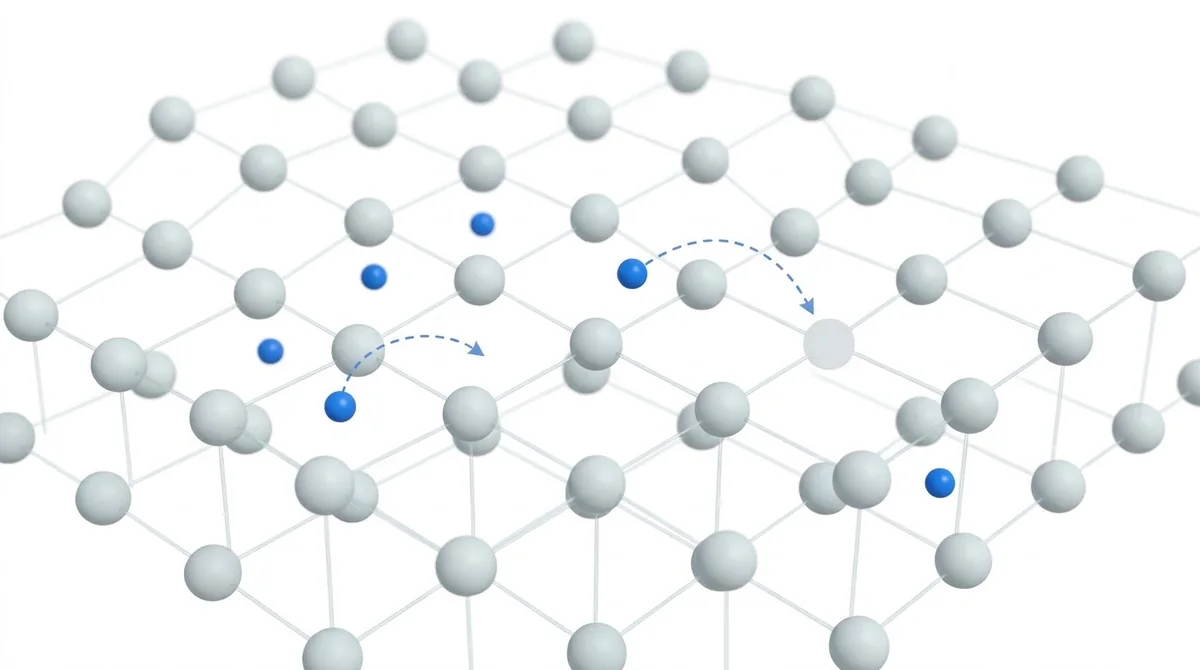
A useful solid electrolyte has to do two things at once. It should conduct ions well, with a target of about 10⁻³ siemens per centimeter (S/cm) at room temperature. It should also conduct electrons poorly, below 10⁻⁸ S/cm, so the cell does not discharge itself through its own middle. A related measure, the transference number, is the share of total conduction that is ionic, with an ideal value close to 1. An electrolyte that let electrons through would act like a short circuit inside the battery.
Liquid Cells Versus Solid-State Cells
A conventional lithium-ion cell has four main parts: a cathode, an electrolyte that conducts lithium ions, a separator, and an anode. The electrolyte in most cells is a liquid solution. In a standard cell, a separator holds the electrodes and the liquid electrolyte apart.
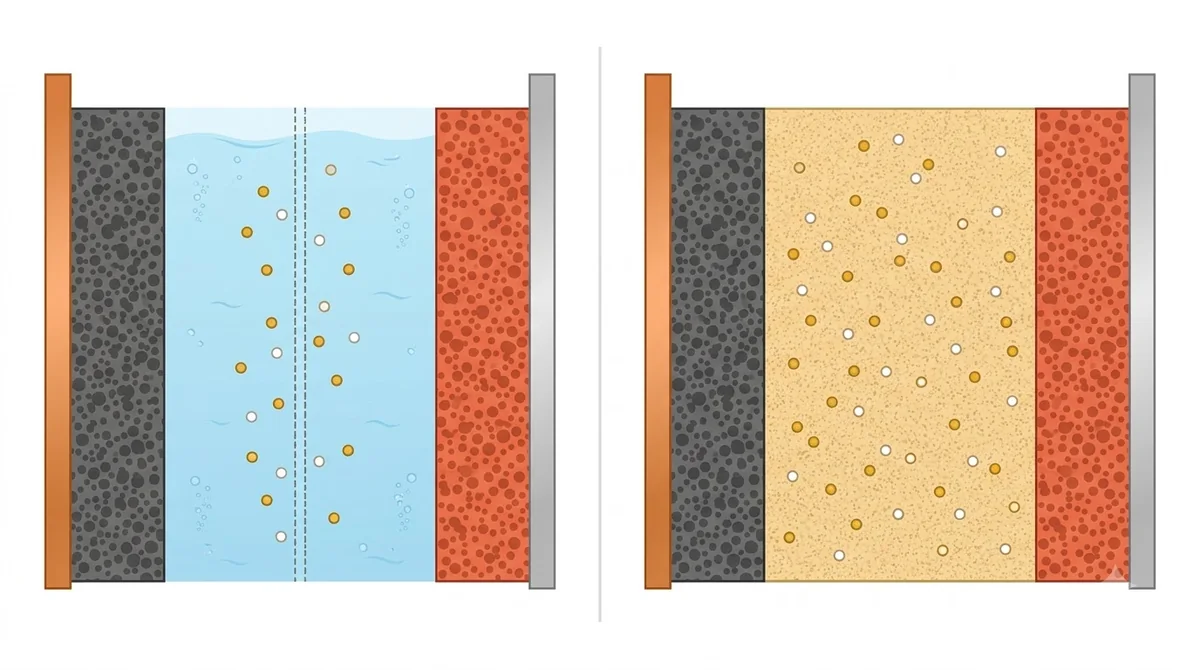
A solid-state design replaces the liquid with a solid electrolyte. Because that solid also keeps the electrodes apart, it does not need a separate separator. One layer does both jobs: it carries the ions and isolates the electrodes.
Solid electrolytes come in several families. Oxides and sulfides are the inorganic types, and solid polymers are a third. Polymers are light and flexible but conduct poorly at room temperature. In one common polymer type, oxygen atoms in the chain grab a lithium ion and release it as the chain segments shift.
Why a Solid Electrolyte May Be Less Prone to Fire
The safety argument starts with what is inside today’s cells. A research review says the organic liquid electrolytes in many commercial batteries are flammable and explosive, which it treats as a potential safety risk. Those liquids can also break down when voltage or temperature rises, which shortens the cell’s useful life.
A research review describes solid electrolytes as non-flammable and non-explosive, and as able to inhibit the growth of lithium dendrites. The Department of Energy’s explainer says solid-state cells are less prone to leakage when damaged or when swelling in hot temperatures, and it presents that as a safety benefit. The same department describes next-generation batteries as less likely to combust, a category broader than solid-state designs alone. These are claims about potential, and how far they hold depends on how the whole cell behaves.
Where the Safety Claim Stops
Removing the liquid does not remove every hazard. The sulfide electrolytes that researchers favor most for conductivity are sensitive to air, and they can decompose into toxic gases, which presents a serious safety problem. Some sulfides also react directly with lithium-metal anodes, forming an interface layer that hinders ion transport.
So a solid can trade one hazard for another. A material that is non-flammable on paper can still cause trouble if it is handled in the wrong air or paired badly with the anode. The research treats the solid electrolyte as the key material for safety performance, and that is a reason to test the whole cell, not just the material on its own.
Contact at the interfaces
A liquid wets every surface it touches. A solid electrolyte and a solid electrode touch only where their surfaces meet, and that contact is hard to make complete. The main challenges are high interfacial resistance, side reactions between the electrolyte and the electrodes, and interface instability. Electrodes also expand and contract as the battery charges and discharges, which can open gaps at the boundary.
The conductivity trade-off
The two main families trade off different strengths. Oxides are chemically and mechanically stable but rigid, need high processing temperatures, and show high resistance at the electrode interface. Making good particle contact with oxides can require very high-temperature sintering. Sulfides conduct far better, with some reaching more than 20 mS/cm at room temperature, but they need a suitable stack pressure during assembly because of how they behave mechanically.
Lithium dendrites
Dendrites are branching lithium filaments that can form during charging. In liquid cells, dendrite formation can puncture the separator and cause short circuits at high currents. Solid electrolytes are said to inhibit dendrite growth, but the risk does not disappear: dendrites can still grow through a solid electrolyte and short the cell, and that is one reason the lithium-metal anode, with its large capacity gain, needs careful engineering.
Manufacturing, Supply, and Cost
Solid-state cells are built differently from liquid-electrolyte cells, including how the electrodes are prepared. Even within solid-state designs, the recipes vary: carbon is used as a conductive additive for sulfide electrolytes but not for oxides. Argyrodite-type sulfides are considered easier to build into batteries than oxide electrolytes.
Supply is another open question. Solid Power, which builds its work around a sulfide-based electrolyte, depends on outside vendors for the materials and tools it needs, among them Li2S, NMC, silicon, lithium metal foil, and production equipment. The filing also points out that certain raw materials come from only a few providers, and that the market may not keep pace with demand. It adds that steep price increases could hurt the business. Scaling up is the larger hurdle: a review says industrial-scale use of solid electrolytes still faces great challenges.
Where Solid-State Batteries Stand Today
Polymer electrolytes have already left the lab and proved commercially workable: a small number of new-energy vehicle power batteries already contain them. That makes solid-state batteries real, but only narrowly, since most solid-state designs are still in development.
Solid Power’s SEC filing describes a Department of Energy assistance agreement providing up to $50 million to pay for equipment for continuous production of sulfide-based solid electrolyte. That money buys production equipment, which is a different thing from a battery that customers can purchase. Continued payments are not guaranteed: a January 20, 2025, executive order put a hold on Bipartisan Infrastructure Law money while it is reviewed, and the filing says the agreement could be delayed or cancelled. DOE keeps the right to halt later payments if a project falls short, if its priorities shift, or if the money runs out.
For a buyer, the practical picture is simple: conventional lithium-ion cells still power consumer electronics and electric vehicles, and solid-state designs are not yet the standard choice.
Claims about higher energy density rest largely on the theoretical capacity of lithium metal, which is 3,860 mAh/g. For comparison, graphite anodes in conventional lithium-ion cells are held back by a theoretical limit of 370 mAh/g. That gap describes the material, not a measured result for a finished cell. What a buyer needs are cell-level figures for energy density and charging speed, measured on finished cells, and those are the numbers to look for in any announcement.
The Trade Behind the Solid
The liquid in a conventional battery carries a real risk, since it is flammable, but it also does the essential job of carrying ions between the electrodes. A solid has to take over that job while staying in close contact with electrodes that expand and contract during charging and discharging. When a company says its battery is safer or charges faster, the useful question is whether that claim rests on a finished product or on a laboratory test.
Fact or Myth?
- In theory, lithium metal can store about ten times more charge per gram than graphite.
Show answer
Fact. Its theoretical capacity is 3,860 mAh/g versus 370 mAh/g for graphite. That is a figure for the material, not for a finished battery. - A solid-state cell does not need a separate separator.
Show answer
Fact. The solid electrolyte both carries the ions and keeps the two electrodes apart. - Solid electrolytes completely stop lithium dendrites from forming.
Show answer
Myth. They can slow dendrite growth, but dendrites can still grow through a solid electrolyte and short the cell. - Solid electrolytes carry no safety risks of their own.
Show answer
Myth. Sulfide electrolytes are sensitive to air and can decompose into toxic gases. - Inside a solid electrolyte, ions move by hopping between empty spots in the crystal.
Show answer
Fact. Under an electric field, an ion jumps into a neighboring vacancy in the crystal lattice.
Sources
- Research Progress on Solid-State Electrolytes in Solid-State Lithium Batteries: Classification, Ionic Conductive Mechanism, Interfacial Challenges – PMC (nih.gov)
- DOE Explains…Batteries (energy.gov)
- Sulfide and Oxide Inorganic Solid Electrolytes for All-Solid-State Li Batteries: A Review – PMC (nih.gov)
- Breaking It Down: Next-Generation Batteries (energy.gov)
- SOLID POWER, INC._December 31, 2024 (sec.gov)