
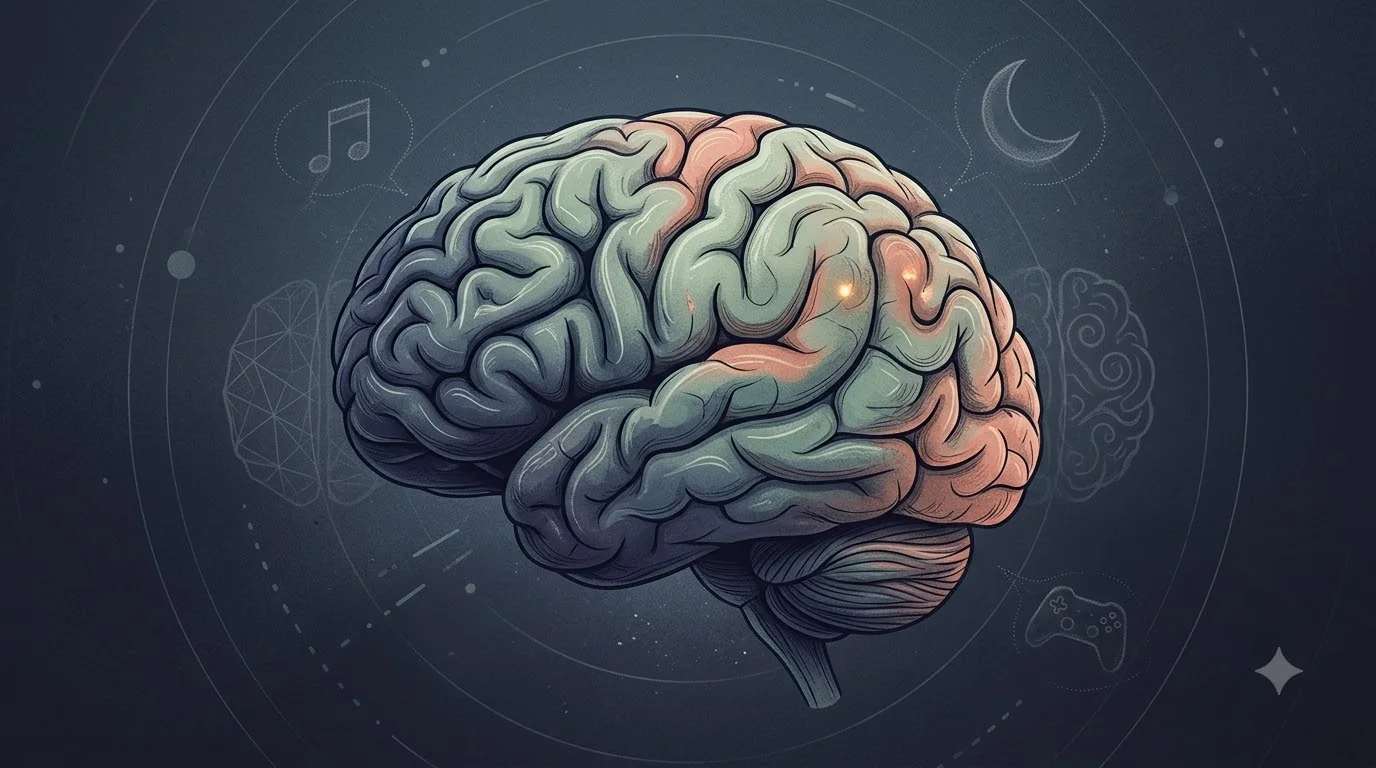
Most popular brain myths start from a real finding that was stretched too far. The 10 percent claim does not survive the evidence, and neither does the notion that each person is either a left-brained or a right-brained thinker. Take the brain’s energy budget as a test case: the organ is a small slice of body weight but draws a large slice of the body’s fuel. Some of these claims are plainly false, while others are only half right, and the difference usually comes down to what the research actually measured.
Myth 1: We use only 10 percent of our brain
Verdict: false. The idea flatters us, since it implies a hidden reserve of talent waiting to be switched on. Brain imaging and damage studies both point the other way.
Where the number came from is still unsettled. One suggested starting point is a reserve-energy theory held by Harvard psychologists William James and Boris Sidis, which they tested in the 1890s on the child prodigy William Sidis. The origin of the myth remains unclear. James’s 1907 article in the journal Science argued that people use only part of their mental resources, but it gave no percentage. The figure then spread through popular print. A 1929 edition of the World Almanac declared that “Scientists and psychologists tell us we use only about TEN PERCENT of our brain power.” Seven years later, Lowell Thomas used a foreword to Dale Carnegie’s book to credit the number to James, who had not specified a percentage in his article.
Brain scans tell a different story, and the difference lies in timing. Regardless of what a person is doing, every brain area registers some activity in an intact brain, though some areas are busier than others at any one time. Imaging with fMRI and PET has shown that many areas stay active even during simple tasks. The fMRI results point the same way, suggesting that most of the brain is in use for most of the time, even during a very simple action. Even during sleep, every part of the brain shows some level of activity. Johns Hopkins neurologist Barry Gordon has put it bluntly: almost every part gets put to use, and most of it is busy nearly all the time.
The damage record points the same way. Almost no area of the brain can be harmed without some loss of ability, and even slight damage to a small area can have a profound effect. One proposed explanation for the myth is that early neurology was misread: in many cortical regions, damage effects are subtle, which left researchers wondering what those regions did.
The energy budget points the same way: the brain is about 2 percent of body weight, yet it can take up as much as 20 percent of the body’s energy. An organ that expensive would be hard to justify if most of it sat idle. An evolutionary argument makes the same point: if most of the brain were unnecessary, smaller and more efficient brains would have carried a survival advantage, and natural selection would have trimmed the idle tissue. Brain cells that sit unused tend to degenerate, and if most of the brain were idle, autopsies of healthy adult brains would show extensive wasting. Knowing Neurons editor Gabrielle-Ann Torre notes that even when resting, much of the brain keeps working through the default mode network, a broad set of regions that stays active and in step even when no task is underway.
Myth 2: Some people are left-brained and others are right-brained
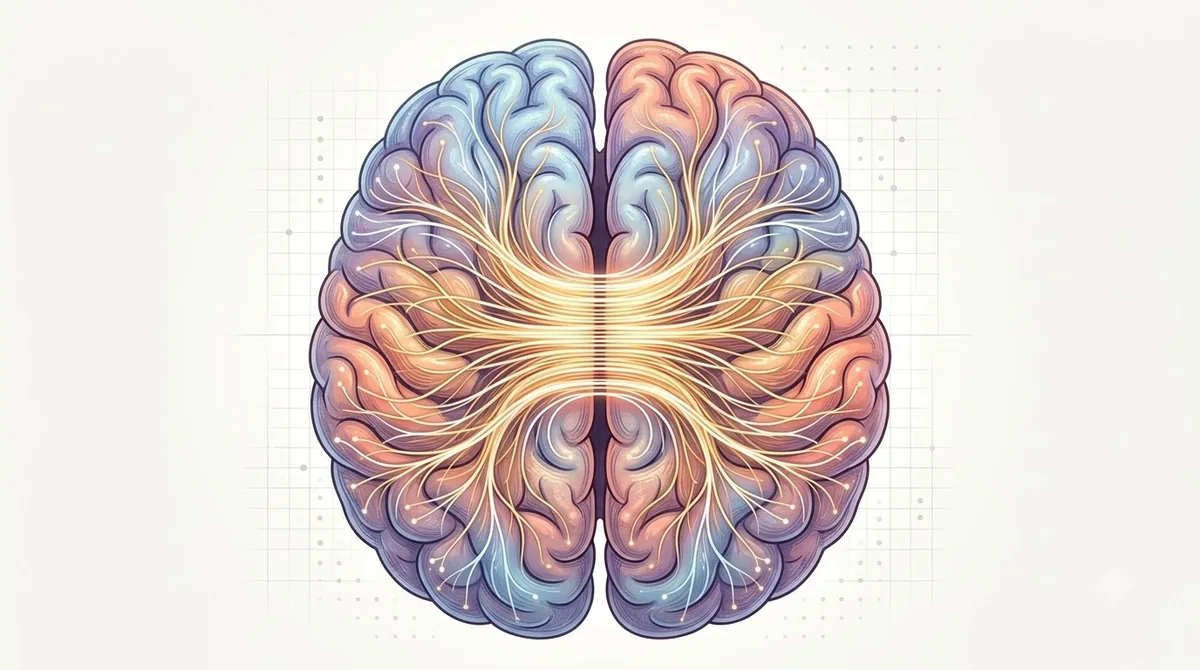
Verdict: misleading. The myth grows from a real finding: the two hemispheres do divide some work. A 2014 PLOS Biology study examined how far language processing depends on the left hemisphere and emotion processing on the right. The trouble starts when that division becomes a personality type. People are not dominated by one hemisphere or the other, and a healthy person is constantly using both. Coordination exercises do not fix a supposedly one-sided brain either. The same answer key marks the statement that the left and right hemispheres always work together as correct. The label is easy to remember, which is part of why it lasts. It turns a real division of labor into a tidy character trait.
Myth 3: Alcohol kills brain cells
Verdict: misleading. Misusing alcohol over time can leave lasting changes in the brain, and those changes can keep alcohol use disorder going and make relapse more likely. The shorter claim that drinking kills brain cells goes further than the evidence, and the reasons are more complicated than that. Some of the most telling effects are not cell death at all. A blackout is a gap in memory for what happened while a person was intoxicated, and it occurs when alcohol briefly interferes with the hippocampus, the brain area that turns short-term memories into long-term ones. Blackouts are common in adolescence too. Among older adolescents who had ever had a drink, one in five reported a blackout in the previous six months, according to one study. Harm is linked to any amount of drinking, and it rises as the amount consumed goes up. Some harms may appear at lower levels of drinking, according to a growing body of evidence, though that point is still debated.
The amount matters, but the myth gets the mechanism wrong: alcohol does not simply kill brain cells, and the reasons are complicated. Harms are linked to any amount of drinking, and they rise as consumption rises.
Put plainly, the question is not whether one drink kills cells but how much risk each amount carries. The lasting brain changes the research ties to alcohol misuse are the clearer case, and they can keep alcohol use disorder going and make relapse more likely.
Blackouts are one of the clearest ways alcohol reaches memory. They are gaps in memory for events during intoxication, because alcohol temporarily blocks memories from moving into long-term storage in the hippocampus. In adolescents, alcohol misuse has also been linked to reduced size in the frontal lobe, hippocampus, amygdala and corpus callosum. These are associations, and research on them is still emerging. Too much alcohol during pregnancy can affect fetal brain development and cause fetal alcohol syndrome.
For scale, a US standard drink is defined by the amount of pure alcohol it contains, so a serving of beer, a glass of wine and a shot of spirits are sized to hold roughly the same amount.
Myth 4: Brain damage is always permanent
Verdict: partly true. Some damage does last, which is why the blanket version feels right. But the brain is not a fixed circuit board. When one region is damaged, other parts can sometimes take over its function. As an imagined illustration, not a case from the research, picture a person who loses a small patch of tissue: whether nearby regions can pick up its work depends on where that patch sits and how large it is. Even slight damage to a small area can have profound effects, so recovery cannot be assumed. The ability to change in response to experience is called brain plasticity, and adolescent plasticity may also help some recovery from alcohol-related changes, though that is still debated. Plasticity means the brain can reorganize, not that every lost ability comes back. The limits are real, and lasting changes from long-term alcohol misuse can persist.
Myth 5: Classical music and video games make you smarter
Verdict: misleading. The “Mozart effect” started with a study that reported a brief boost on a spatial reasoning test after listening to Mozart.
Brain training produced a more specific result. In a 2017 study, researchers followed participants for a decade and found that those who had used brain-training exercises cut their dementia risk by 29 percent. That is a finding about dementia risk, not proof that brain exercises raise general intelligence. Commercial video games are a separate question, and this finding does not answer it.
Other findings focus on demanding activities people choose for their own sake. Mentally demanding pursuits, such as mastering a second language or a musical instrument, can boost neural plasticity and build denser synaptic wiring. Attention-training tools such as neurofeedback systems can help people work on attention control, though that is a narrower goal than general intelligence.
Sustained, demanding practice is the sort of experience the brain responds to, since plasticity lets it change in response to experience.
Myth 6: A bigger brain means higher intelligence
Verdict: misleading. Brain size alone does not tell you how sharp someone is. Lorber reported a Sheffield University student with a measured IQ of 126 who earned a mathematics degree, even though hydrocephalus had reduced his cortex so much that he had hardly any discernible brain tissue. Reviewers pointed out that Lorber’s scans showed the brain tissue was still there, just packed into the space that remained, possibly at a higher density than usual.
So the case is a striking anecdote, not a rule. Across larger groups, brain volume shows a modest link to test scores, which is a correlation, not a blueprint. What seems to matter more is how the parts connect and coordinate. The brain works something like a symphony, where synchronization and energy management shape the quality of the performance.
Myth 7: Brains stop changing after childhood
Verdict: false. The idea that brain development wraps up by secondary school does not hold, because brain organization and functioning keep changing into a person’s mid-20s. The prefrontal cortex, which handles planning and decision-making, is among the last areas to mature. The idea that brain development is finished by secondary school is also marked incorrect.
Adults keep forming connections, too. Production of new connections can continue into old age. Learning mostly works by changing connections between existing cells rather than adding new cells. Sensitive periods, when some skills come more easily, are real. The idea that certain things can never be learned after childhood is marked incorrect. Intelligence is not fixed by heredity alone, either.
Whether adults grow new neurons in the hippocampus, a region tied to learning and memory, is debated and not settled. Any claim on that point deserves caution. Learning later in life is possible, and the evidence on connections supports that.
Myth 8: You can learn a language while you sleep
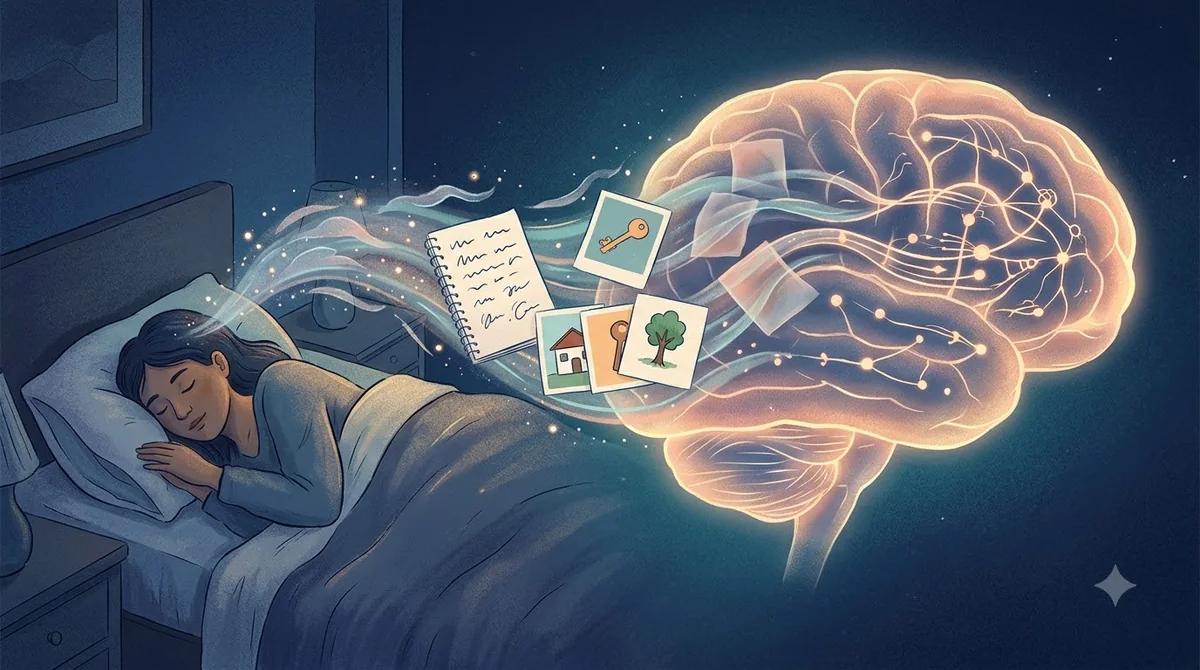
Verdict: misleading. Sleep does real work for memory, consolidating what you learned so that it lasts. Consolidation works on material you have already taken in, so it cannot stand in for studying. The useful advice is simple: study first, then sleep.
Why these myths keep spreading
Most of these myths start with a real finding that got stretched, and a claim with a real kernel is easy to believe. The OECD’s 2002 definition of a neuromyth describes a misconception generated by a misunderstanding, misreading or misquoting of established brain research. Surveys give the clearest measure of how widespread the 10 percent idea is. An older survey from 2013 found that around 65 percent of Americans believed we use only 10 percent of our brains.
The idea is not limited to the general public. The study’s authors say it is still unclear where teachers’ incorrect ideas come from, whether books, colleagues or commercial companies. Why the claim keeps circulating is a separate question, and the answers are hypotheses rather than settled findings. One plausible explanation is repetition: the claim has appeared in articles, television programs and films, which helps explain why it is so widely believed. Some brain-based educational programs claim to be grounded in neuroscience but lack scientific validation. Commercial companies are one candidate source, though how much they contribute remains an open question.
The question worth asking
When a brain claim promises a hidden reserve, a quick fix or a fixed personality, ask where the real finding ends and the stretch begins. Most of these myths sit right at that edge. The brain does specialize, alcohol does harm, and the brain does change, but each popular claim runs past the evidence.
Fact or Myth?
- We use only about 10 percent of our brain.
Show answer
Myth. Imaging shows activity across the whole brain, even during sleep, and almost no area can be damaged without some loss of ability. - The brain is about 2 percent of body weight but can use up to 20 percent of the body’s energy.
Show answer
Fact. That high energy cost is one reason scientists doubt most of the brain could sit idle. - People are either “left-brained” or “right-brained.”
Show answer
Myth. The two hemispheres divide some work, but healthy people use both constantly. It is not a personality type. - Brain development is finished by the end of high school.
Show answer
Myth. Brain organization keeps changing into the mid-20s, and the prefrontal cortex is among the last areas to mature. - You can learn a new language by listening to recordings while you sleep.
Show answer
Myth. Sleep consolidates what you have already learned, but it cannot replace studying. Study first, then sleep.
Sources
- Frontiers | Neuromyths in Education: Prevalence and Predictors of Misconceptions among Teachers (frontiersin.org)
- Ten-percent-of-the-brain myth – Wikipedia (wikipedia.org)
- How much of our brain do we actually use? Brain facts and myths (medicalnewstoday.com)
- Beyond the Myth That We Use Only 10 Percent of Our Brains (psychologytoday.com)
- Understanding Alcohol Drinking Patterns | National Institute on Alcohol Abuse and Alcoholism (NIAAA) (nih.gov)
- Alcohol and the Adolescent Brain | National Institute on Alcohol Abuse and Alcoholism (NIAAA) (nih.gov)